Sealing Methods Compared for Granular Bag Lines
The sealing stage is where a packing line commits to its film for life, and the three common sealing methods differ more than their prices suggest. Thermal bars, pulse wires and ultrasonic horns each bond film differently, and granular bag lines feel those differences at the worst times.
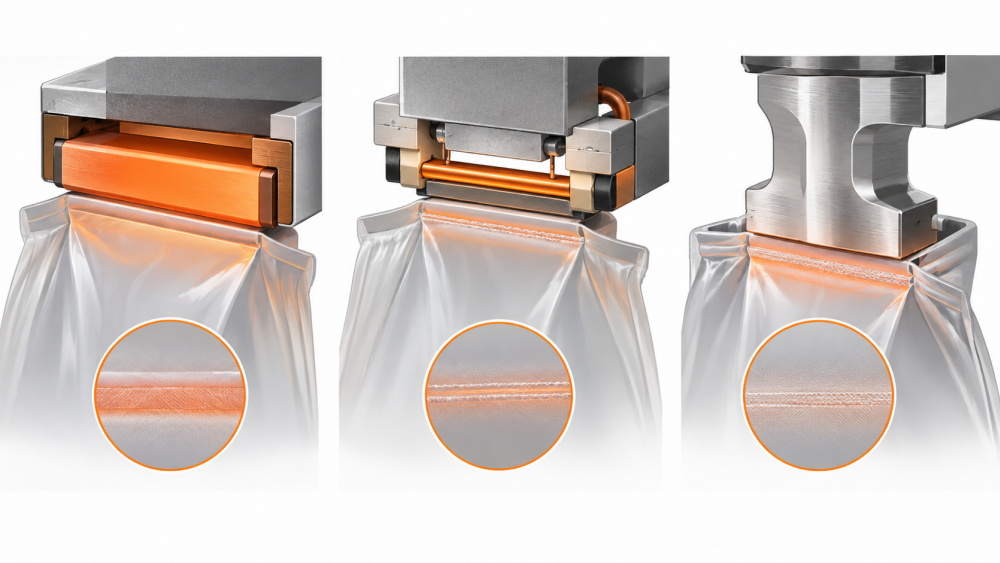
Constant-heat bars: the workhorse: Heated bars held at temperature close on the bag mouth and melt the inner layers together. The method is simple, robust and suited to the polyethylene inner layers common on rice and seed bags. Its weaknesses show on thick laminates, where heat soaks through and can wrinkle outer layers, and in dusty environments, where residue builds on the bar and needs scheduled cleaning. Most sealer vacuum packaging machine builds at industrial granule lines use this method, and spare bars are cheap and widely available.
Pulse sealing: heat only when needed: A resistance wire heats intensely for a fraction of a second and then cools. Heat exposure of the film is minimal, which suits high-barrier laminates and thick structures where outer-layer damage is unacceptable. The wire is a consumable with a finite life, and its replacement on a vacuum packaging machinery line is a routine task that spare-parts planning must anticipate. Where premium brick bags with printed laminates are the norm, pulse sealing earns its extra complexity.
Seal width and jaw pressure matter alongside method: Whatever the method, the seal must survive handling. Wide seals on heavy bags distribute stress; jaw pressure must be even across the full width, which is a machining question as much as a settings one. A vacuum packaging machinery quote that omits seal width and pressure specification is incomplete for granular duty.
Choosing by film first: Identify the film structure with the material supplier, then match the sealing method to it, not the reverse. Changing film after installation is far costlier than changing method on paper. Zhangzhou Jialong Technology Co., Ltd. matches sealing hardware to bag specifications and documents the pairings at https://jialongpacking.com/ for project teams.
Before accepting automatic vacuum packer, run one deliberate changeover on the granular product line and log how many bags it takes to return to target.
For mixed materials, automatic vacuum packer recipes should be stored separately even when the bag size stays the same.
If integrated packaging line alarms repeat on the same shift, treat the message list as a clue rather than a nuisance.
Small producers often delay industrial vacuum packaging maintenance until a seal fails; a weekly ten-minute check is cheaper than that delay.
A vacuum packaging machinery checklist works best when it names the person responsible, not just the task.
A sealer vacuum packaging machine must match its sealing method to the film and duty cycle. Thermal bars suit most granular bags, pulse seals handle delicate films, and ultrasonic bonding serves niche formats. On an automatic vacuum packer, industrial vacuum packaging and integrated packaging line logic decide how these methods interact. Ask for a sealing test with your own film before you commit.
Industrial vacuum packaging with the right sealing method holds quality across shifts. On an integrated packaging line, each method should be tested against your film, product and duty cycle before the order is placed. A short run on your own material settles the question faster than a brochure.
A sealer vacuum packaging machine should be tested with your own film and product before the order is placed. Seal temperature, dwell time and vacuum depth interact, and a short run on your material reveals the combination that holds.