The Evolving Vacuum Packaging Machine: Automation, MAP, Flexible Formats, and Data-Driven Control
The Evolving Vacuum Packaging Machine: Automation, MAP, Flexible Formats, and Data-Driven Control
Published on: June 26, 2026
A vacuum packaging machine used to be selected mainly by chamber size, pump capacity, sealing length, and cycle speed. Those points still matter, but they no longer describe the full value of the equipment. Modern buyers also need repeatable recipes, stable seal quality, hygienic design, flexible changeover, gas flushing options, traceability, and compatibility with newer film structures.
The industry is shifting from simple air removal to controlled preservation. A suitable industrial vacuum packaging machine should protect shelf life, reduce avoidable waste, support operator safety, and produce data that helps the factory understand what happened during each batch.
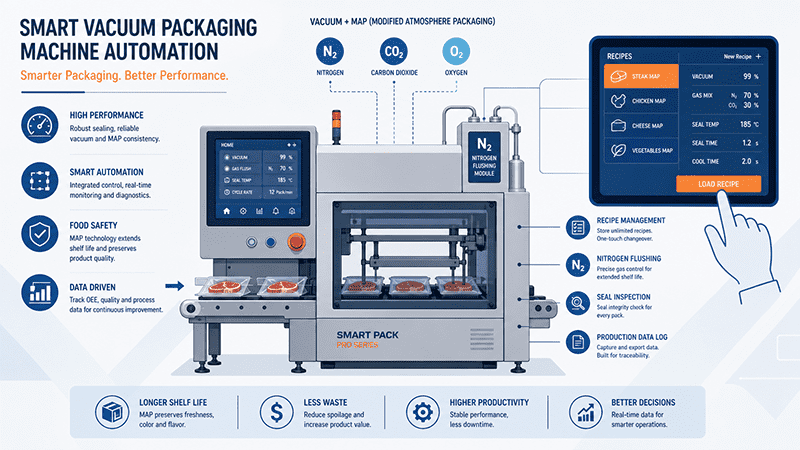
Automation Is Moving From Speed to Repeatability
A fully automatic vacuum packing machine can reduce manual loading, improve handling rhythm, and support higher output. The more important change is recipe repeatability. Different films, pouch sizes, product shapes, and preservation targets require different settings for vacuum time, sealing temperature, dwell time, cooling time, and gas flushing.
Touchscreen controls, PLC recipes, password levels, alarms, and production logs help reduce shift-to-shift variation. Remote monitoring and predictive maintenance can also help maintenance teams identify pump, seal wire, sensor, or pneumatic issues before they become downtime.
MAP and Nitrogen Flushing Add Preservation Options
A vacuum packaging machine with nitrogen flushing is useful when the product needs low oxygen exposure without excessive compression. For fragile foods, powdered products, or products where appearance matters, gas flushing can cushion the package while reducing oxygen. Modified atmosphere packaging can also use controlled gas mixtures for products such as meat, cheese, bakery goods, or fresh prepared foods.
The buyer should not treat gas flushing as a simple add-on. The machine must control vacuum level, gas flush time, residual oxygen, seal quality, and package headspace. Gas supply stability and sensor calibration also become part of the process.
| Trend | What changes in the machine | Buyer check |
|---|---|---|
| Recipe automation | Stored settings for vacuum, seal, cooling, and gas. | Confirm recipes can be locked and logged. |
| Flexible formats | Faster changeover for pouches, trays, and rollstock formats. | Measure real changeover time with operators. |
| MAP and nitrogen flushing | Controlled gas flush and residual oxygen management. | Test residual oxygen and seal integrity. |
| Material innovation | More precise sealing for high-barrier or recyclable films. | Validate seal window, puncture, and vacuum decay. |
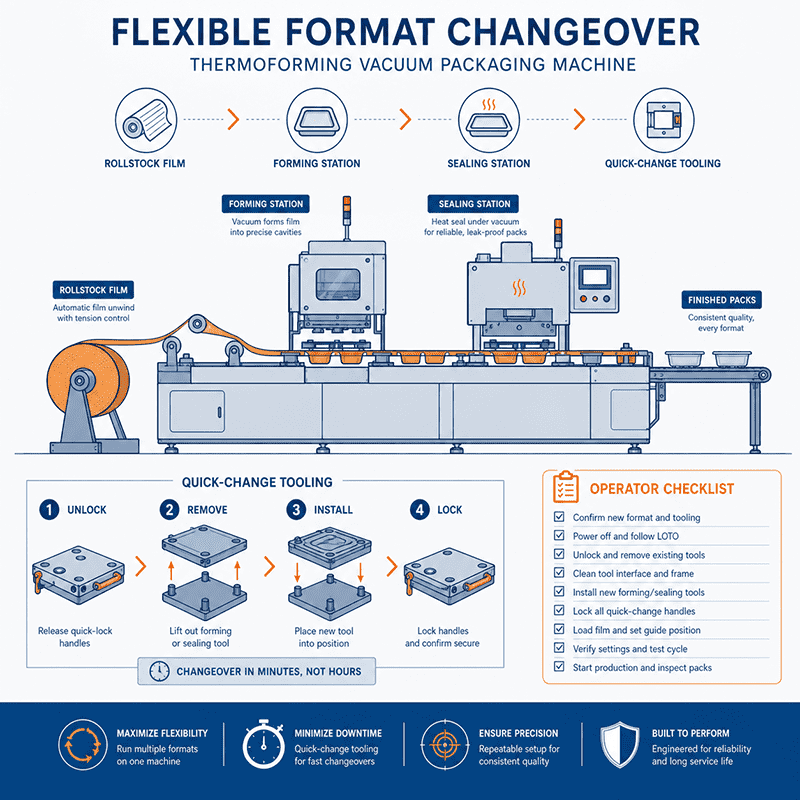
Flexible Formats Are Becoming More Important
Many factories no longer run one product and one package size all day. They need small batches, seasonal products, e-commerce packs, retail pouches, and bulk formats. A thermoforming vacuum packaging machine may be suitable for high-volume rollstock production, while chamber machines, double-chamber machines, rotary systems, or external vacuum systems may fit other product and output needs.
Flexibility should be measured during a real changeover. Buyers should check tool-free adjustments, recipe recall, sealing jaw changes, forming depth, loading space, film path access, cleaning time, and the first-pass quality after restart.
Sustainable Packaging Depends on Machine Precision
Newer films may be thinner, higher barrier, recyclable, or easier to separate by material stream. These materials can be useful, but they also require more precise sealing control. If the temperature window is narrow, the vacuum packaging machine must hold stable heat, pressure, dwell time, and cooling.
The sustainability result should be measured by total waste. A lighter film is not a better choice if it increases leaks, product spoilage, or repacking. Machine trials should include seal strength, vacuum decay, puncture resistance, and shelf-life testing with the final film.
External references: GS1 Digital Link, FDA Packaging & Food Contact Substances, and ISO 12100 machinery risk assessment.
What Buyers Should Verify Next
Confirm recipe storage for vacuum, seal, cooling, and gas flushing settings.
Test the industrial vacuum packaging machine with the final product and film.
Measure changeover time and first-pass quality after restart.
Check whether codes and labels remain readable after vacuum packaging.
Validate newer films by seal strength, vacuum decay, puncture risk, and shelf-life result.
Contact our engineering team directly:
Email: export@jialong.cn
WhatsApp: +86-136-2579-4992
Products: vacuum packaging machine