Why Vacuum Degree Separates a Rice Brick from a Leaky Bag
Two quotations can both promise "-0.1 MPa" and still produce very different rice. What matters is not the number alone but how the machine reaches it, how fast, and what happens to the grain while it does. Vacuum degree is a process parameter, and a rice vacuum packing machine lives or dies by how well it is managed. In rice brick production, the film structure around the rice vacuum packing machine output matters as much as the evacuation curve: a cheap monolayer undoes what a good pump delivers.
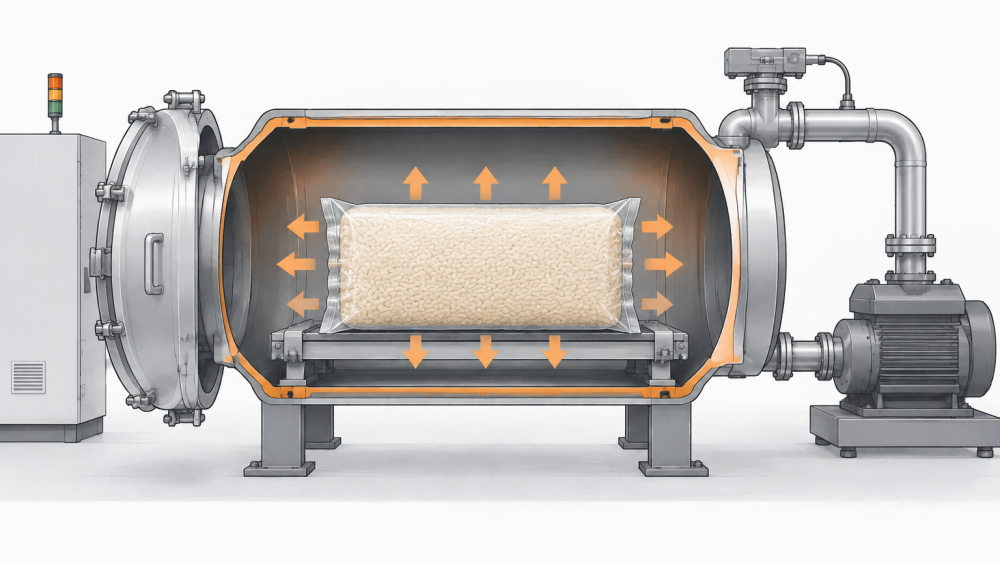
What the pressure figure actually describes: Vacuum degree measures how far pressure inside the chamber falls below atmosphere. Deeper is not automatically better. Grains are rigid but not indestructible, and when a bag collapses hard against a dense mass of rice, trapped air between grains escapes through the grain bed. Over-aggressive evacuation on brittle varieties produces broken grains; softer evacuation leaves air that slowly re-inflates the bag during storage. Training that covers the rice vacuum packing machine pump, the sealer and the film interaction together produces fewer unexplained rejects than training each subsystem in isolation. New operators on a vacuum packaging machine line benefit from a one-page station checklist rather than a dense manual, because habits form in the first week. The brick shape vacuum packing machine works best when the film, pump and sealer are treated as one system rather than three separate purchases.
Pumping speed shapes the cycle: On many lines, a grain vacuum packing machine reaches its target pressure along a curve set by pump displacement and chamber volume. A slow pull lets air escape gradually, gentle on the product but slow in cycle time. A fast pull slams the bag down. Practical lines compromise: strong initial evacuation, then a short hold at target inside the vacuum packaging machine so remaining pockets equalize. When comparing quotations, ask for the evacuation curve rather than the endpoint number on the vacuum packaging machine datasheet. The detail most datasheets omit is the difference between grain vacuum packing machine on paper and the same unit on your floor.
Brick formation depends on the window: A brick shape vacuum packing machine presses the bag while it is still compliant under vacuum. Press too early and air remains, giving a soft brick that puffs later. Press too late and the bag has hardened around uneven grain distribution, leaving lumps and ridges. The usable window is short, which is why pressing plates, evacuation timing and sealing need coordination by the same control system rather than separate operators. A rice vacuum packing machine quotation should state demonstrated cycle time at your bag weight, not a peak number measured under ideal conditions. For rice brick, brick shape vacuum packing machine sealing protects product value that is often higher than the cost of the packaging material. In rice brick production, a low quote can turn expensive once film waste, rejected bricks and unplanned service visits enter the same calculation.
Seal integrity closes the loop: All the pressure work is wasted if the seal leaks. Dust from rice milling settles at the bag mouth, and even a thin layer creates a channel. Good practice combines a clean sealing area, correct jaw temperature for the film, and a periodic underwater bubble test on sampled bags. A vacuum packaging machine spec that omits seal-width and jaw-pressure details is incomplete for production purchasing. One snack producer discovered that switching film suppliers changed how the brick shape vacuum packing machine seal behaved on the same machine.
Matching spec to product: One detail that matters: long-grain, short-grain, parboiled and fragrant rice behave differently under evacuation, and moisture content shifts the picture again. The workable approach is trial packs with your own rice at two or three evacuation settings, measuring broken-grain percentage and bag hardness. Zhangzhou Jialong Technology Co., Ltd. Lists rice line configurations at https://jialongpacking.com/ for teams arranging trials. On a grain vacuum packing machine, seal width, jaw temperature and dwell time belong in the batch record; drift there turns into scrap before anyone notices.