Vacuum Packaging for Granular Materials: Barrier Films, Valves, and Precision Control
Vacuum Packaging for Granular Materials: Barrier Films, Valves, and Precision Control
Published on: June 29, 2026
A granule packing machine is now judged by more than whether it can pull a tight pack. For coffee, seeds, spices, rice, fertilizer granules, and dry chemical materials, buyers want stronger oxygen and moisture control, better puncture resistance, lower dust loss, and more stable sealing performance.
One important trend is film performance. High-barrier structures and stronger surface protection help reduce oxygen entry, moisture gain, and abrasion during transport. For sharp or irregular granules, puncture resistance matters as much as vacuum level.
Another trend is valve integration. Coffee and other gas-releasing products may need a one-way degassing valve so the pack can release internal gas without letting oxygen back in. That means the vacuum packaging machine must handle valve position, seal consistency, and final pack appearance together.
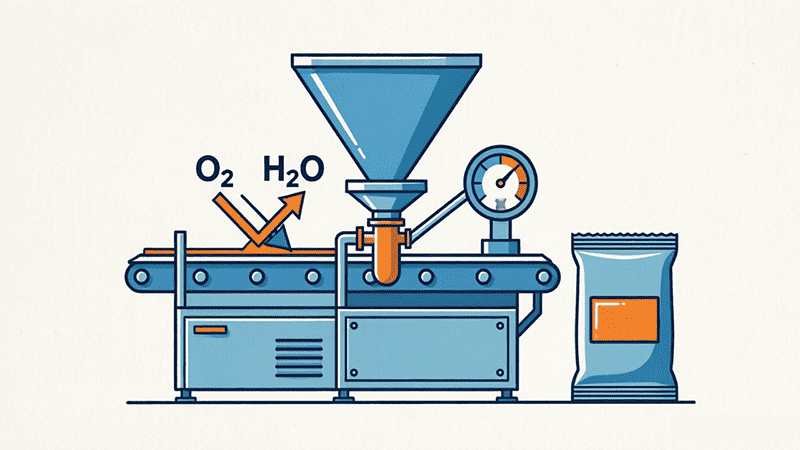
Modern control systems also matter. Different granule sizes and densities behave differently under vacuum. A good industrial vacuum packaging machine should store recipes for vacuum time, seal temperature, cooling, and package firmness instead of using one setting for every product.
For e-commerce and export routes, compact packs and durable seals are important. The buyer should check drop resistance, carton compression, leak risk, and code readability after transport simulation. A dense package that fails in shipment is not an efficiency gain.
In practice, granular products rarely fail for only one reason. A pouch may look acceptable at the machine outlet and still show problems later because several small factors are working together. Fine dust can sit in the seal zone. Hard particle edges can stress the pouch corners. A film that looks strong in a data sheet can still react differently when the actual product rubs against it during cartoning and transport. That is why experienced buyers do not judge a granule packing machine by vacuum degree alone. They judge the full packaging result after the product has moved through filling, sealing, cooling, stacking, and normal handling.
Seal cleanliness deserves more attention than many teams give it. Granular materials are not always free-flowing in a neat, predictable way. Some products create dust, some bounce into the seal area, and some settle unevenly in the bag. If the filling path, bag forming area, or settling step is not well matched to the product, the package may develop intermittent leakage even though the machine settings look correct. A stable line therefore depends on product flow control, pouch presentation, and sealing discipline at the same time.
Another point buyers often discover late is that laboratory performance and commercial performance are not always the same. A short sample run can produce attractive packs because the machine is clean, the product condition is controlled, and the operator is watching every cycle. Real production is less forgiving. Product lots change, humidity changes, shift conditions change, and the line has to keep producing through those variations. For that reason, a realistic acceptance test should run long enough to show whether the package stays stable when the process is no longer in a showroom condition.
Storage route also changes what "good packaging" actually means. Coffee for local retail may need one balance of firmness, valve behavior, and appearance. Seeds moving through export distribution may need another. Chemical granules or fertilizer products may place more emphasis on abrasion resistance and seal protection than on premium shelf appearance. The machine choice is better when the buyer starts from the real route and real product behavior instead of asking for one universal setting that is supposed to fit everything.
For many factories, the most useful improvement is not a dramatic equipment change but tighter process discipline around a capable line. Record the approved recipe, keep the final film specification fixed during validation, inspect leak risk after handling, and compare results across shifts. Those steps sound ordinary, but they usually separate a pack that merely looks vacuum-sealed from a pack that continues to protect granular material through storage, shipping, and final delivery.
External references: ASTM F1927 and GS1 Digital Link.
Contact our engineering team directly:
Email: export@jialong.cn
WhatsApp: +86-136-2579-4992
Products: granule packing machine