Vacuum Packaging for Granular Materials: Future Trends in Automation, Traceability, and Barrier Films
Vacuum Packaging for Granular Materials: Future Trends in Automation, Traceability, and Barrier Films
Published on: June 24, 2026
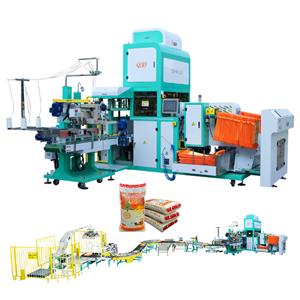
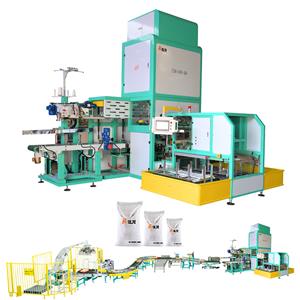
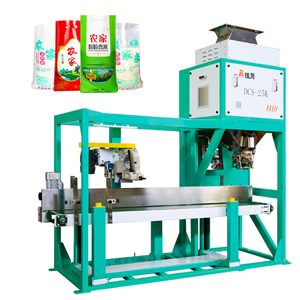
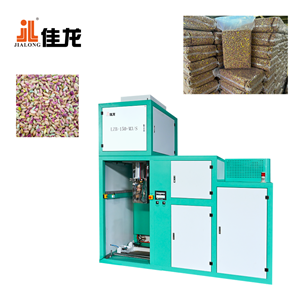
A granule packing machine is no longer judged only by whether it can pull a tight vacuum. For coffee beans, nuts, rice, seeds, spices, fertilizer granules, and dry chemical particles, the better question is whether the full vacuum packing system can keep product quality stable through filling, sealing, storage, and transport.
The next stage of granular vacuum packaging is more controlled and more data-driven. Buyers will pay more attention to product-specific vacuum recipes, film barrier performance, seal integrity, online inspection, traceability codes, and material sustainability. The machine still matters, but the process around the machine matters just as much.
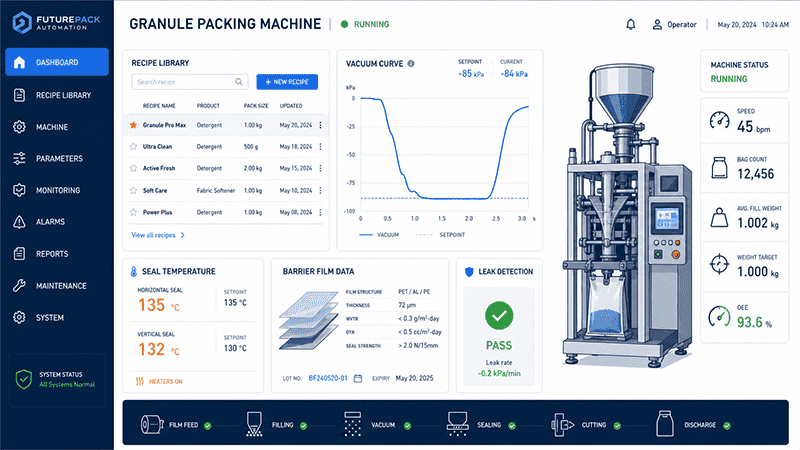
Trend 1: Recipe-Based Automation Becomes Standard
Granular products do not behave the same way under vacuum. A coffee product may need stronger oxygen control. A seed product may need gentler handling. A hygroscopic granule may need better moisture protection. An automatic vacuum packing machine should therefore store recipes by product, bag size, film type, filling weight, target vacuum level, and sealing temperature.
This avoids one common mistake: running every product under the strongest vacuum setting. Excessive compression can break fragile granules, create hard pouch corners, or stress the film. The future direction is not maximum vacuum; it is repeatable vacuum with controlled product damage.
Trend 2: Barrier Film Selection Becomes More Product-Specific
Vacuum packaging works only if the pouch remains a barrier. Oily granular foods need oxygen protection to slow rancidity. Aromatic products need better aroma retention. Sugar, seeds, and some chemical granules need moisture control to reduce caking. PET/PE and NY/PE structures are common, but buyers should compare oxygen barrier, moisture barrier, puncture resistance, and seal-window data before approving a film.
ASTM F1927 is one recognized method for measuring oxygen gas transmission through barrier materials under controlled relative humidity. For food-contact packaging, FDA food contact substance guidance is also relevant when films, inks, adhesives, valves, or zipper parts may contact food.
| Future requirement | Why it matters | Buyer check |
|---|---|---|
| Recipe control | Different granules need different vacuum curves. | Store settings by product and film. |
| Barrier film data | Shelf life depends on oxygen and moisture protection. | Review OTR, WVTR, puncture, and seal range. |
| Leak detection | A small channel can destroy the vacuum benefit. | Add vacuum decay or seal inspection in the trial. |
| Traceability | Export and e-commerce channels need clearer batch data. | Connect QR or batch code to production records. |
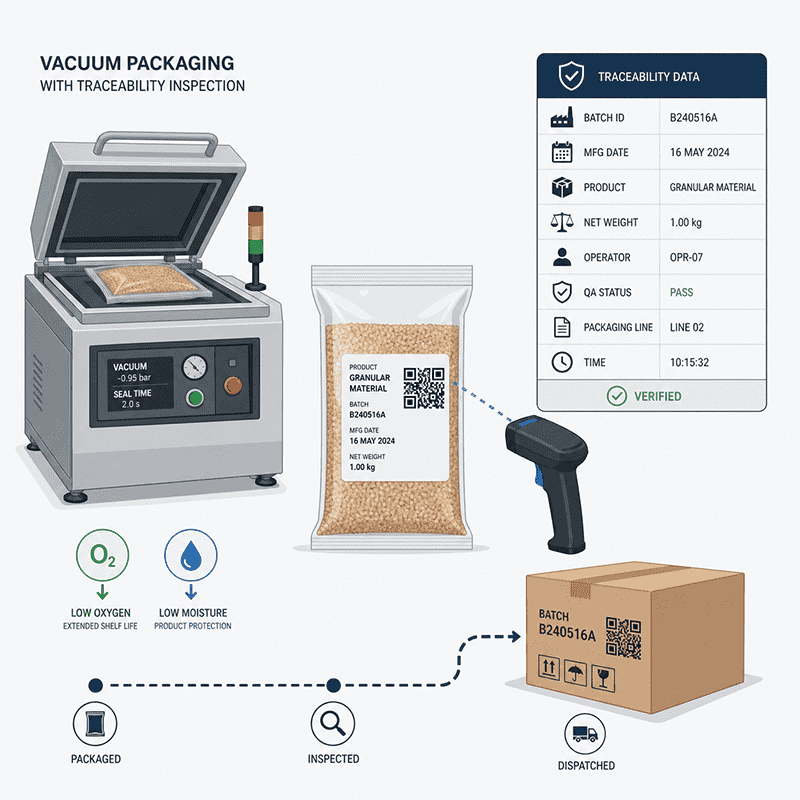
Trend 3: Smart Packaging Moves From Label Design to Batch Data
Smart packaging does not need to be complicated at the beginning. A QR code or GS1 Digital Link can connect a pack to batch information, product origin, shelf-life instructions, or recycling information. For granular products shipped across long routes, that link can help distributors and consumers check more than the printed label.
The packaging line should be ready for this change. Code position, print quality, seal area, pouch shape, and carton handling must support readable codes after vacuum packaging. A clear code is only useful if it survives production and distribution.
Trend 4: Sustainability Will Be Tested Against Performance
Recyclable and lower-material packaging will keep gaining attention, but granular vacuum packaging has a practical constraint: the film must still protect against oxygen, moisture, puncture, and seal failure. A thinner or more recyclable structure is not useful if it increases leakage, caking, or product waste.
The right approach is to test sustainability and performance together. Buyers should compare package weight, barrier data, shelf-life result, leak rate, and product damage before changing film structures.
External references: ASTM F1927 oxygen transmission rate test method, FDA Packaging & Food Contact Substances, and GS1 Digital Link.
Practical Buying Checklist
Test the granule packing machine with the actual product, not a substitute sample.
Store separate recipes for fragile, oily, aromatic, and moisture-sensitive granules.
Check seal quality when normal dust and fines are present.
Verify code readability after vacuum packaging and carton handling.
Compare sustainable film options by barrier data and leak rate, not appearance alone.
Contact our engineering team directly:
Email: export@jialong.cn
WhatsApp: +86-136-2579-4992
Products: granule packing machine