Vacuum Packaging for Granular Materials: Moisture Control, Barrier Film, and Vacuum Recipe Design
Vacuum Packaging for Granular Materials: Moisture Control, Barrier Film, and Vacuum Recipe Design
Published on: June 8, 2026
A granule packing machine should not use one vacuum setting for every granular product. Coffee beans, rice, nuts, seeds, sugar, spices, and dry chemical granules behave differently under vacuum. Some products lose aroma when oxygen remains. Some absorb moisture and cake. Some crack when the vacuum draw is too aggressive.
The useful goal is not maximum vacuum. The useful goal is a stable package that controls oxygen, moisture, foreign odor, seal leakage, and particle damage. That requires matching the material, film, vacuum recipe, and storage condition before the line is released.
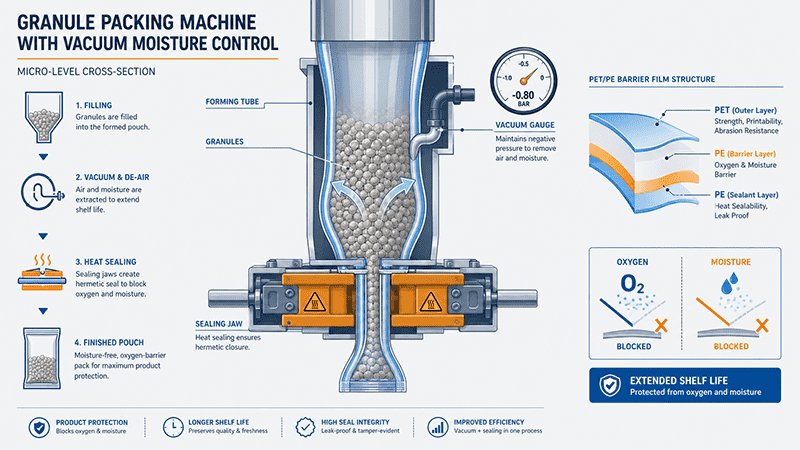
Barrier Film Is the First Engineering Decision
Granular products usually need films with oxygen and moisture barrier performance. PET/PE and NY/PE structures are common starting points, but the final choice depends on product hardness, oil content, aroma sensitivity, bag weight, and sealing speed. A coffee vacuum packaging machine may need stronger aroma and oxygen control, while sugar or seed packaging may need stronger moisture protection.
Barrier claims should be verified by test methods, not by supplier language alone. ASTM F1927 covers oxygen gas transmission rate through films and barrier materials at controlled relative humidity. That type of film data helps buyers compare packaging structures before running long shelf-life trials.
| Granular material | Main risk | Machine check |
|---|---|---|
| Coffee beans | Aroma loss and oxidation | Validate the coffee vacuum packaging machine with final film and storage time |
| Seeds | Moisture gain and germination loss | Control sealing temperature and warehouse humidity |
| Nuts | Rancidity and kernel breakage | Adjust vacuum draw and package firmness |
| Sugar or hygroscopic granules | Caking and clumping | Test moisture barrier and seal leakage after storage |
Vacuum Intensity Must Match Particle Strength
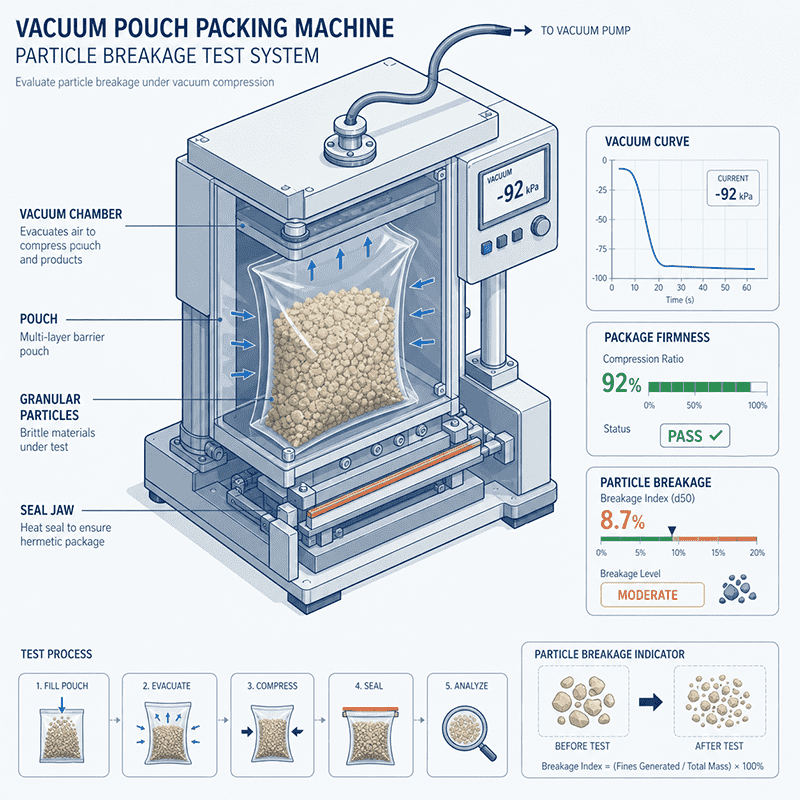
A vacuum pouch packing machine can remove air pockets and reduce package volume, but hard vacuum is not always better. Fragile granules can crack, and irregular particles can puncture a thin pouch. A staged vacuum draw is often safer than one fast pull when the product has brittle edges.
The line should store recipes by product, bag size, film thickness, target residual oxygen, and acceptable package firmness. That prevents operators from running seeds, coffee beans, and nuts under the same vacuum curve.
Dust and Fines Can Destroy Seal Quality
Granular products often contain fines. Coffee chaff, spice dust, seed fragments, or chemical powder can sit in the seal area and create micro-channels. The industrial vacuum packaging machine should include practical product settling, filling control, and seal-area cleanliness checks before speed is increased.
For food products, film, ink, adhesive, zipper, and valve components should be reviewed as food-contact materials. FDA's food contact substance guidance is a useful reference when buyers approve new packaging structures.
External references: ASTM F1927 oxygen transmission rate test method and FDA Packaging & Food Contact Substances.
Commissioning Checklist
Run the granule packing machine with the actual product, not a substitute granule.
Confirm oxygen and moisture barrier data for the final film structure.
Check seal strength after dust exposure and after storage.
Measure particle breakage before and after vacuum packaging.
Store finished packs in a cool, dry, low-light area when the product is moisture or aroma sensitive.
Contact our engineering team directly:
Email: export@jialong.cn
WhatsApp: +86-136-2579-4992
Products: granule packing machine