Vacuum Packaging for Granular Materials: Shelf Life, Pallet Density, and Seal Integrity
Vacuum Packaging for Granular Materials: Shelf Life, Pallet Density, and Seal Integrity
Published on: June 22, 2026
A granule packing machine does more than remove air. For coffee, nuts, rice, seeds, spices, sugar, and dry chemical granules, vacuum packaging can slow oxygen-driven quality loss, reduce moisture ingress, make packages denser, and create a visible tamper-evident pack shape.
The risk is assuming that all benefits appear automatically. They do not. A vacuum packing system must be matched to film barrier, particle strength, seal cleanliness, carton compression, and storage conditions. Otherwise, a compact package can become a cracked, leaking, or caked package.
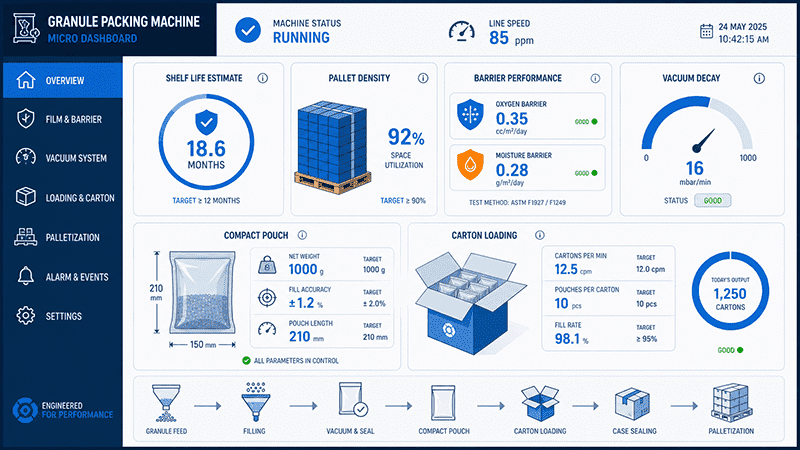
Shelf Life Depends on Barrier and Seal Integrity
Oxygen removal slows rancidity in oily granules such as nuts and some coffee products. It also helps protect volatile aroma in coffee, herbs, and spices. The package only keeps that benefit when the film barrier and seal remain stable through storage and transport.
A granule packaging machine should therefore be tested with final film, final product, and final carton handling. Oxygen transmission data, moisture barrier data, vacuum decay, seal peel strength, and product breakage should be reviewed in one acceptance file.
| Benefit | Failure risk | Engineering check |
|---|---|---|
| Longer shelf life | Oxygen returns through pinholes or weak seals | Vacuum decay and film barrier review |
| Moisture prevention | Caking in hygroscopic granules | Storage test under defined humidity |
| Higher pallet density | Hard pack corners stress film | Compression test after the vacuum pouch packing machine cycle |
| Tamper evidence | Pack shape varies by product bed | Recipe control by product and bag size |
Logistics Efficiency Has a Mechanical Limit
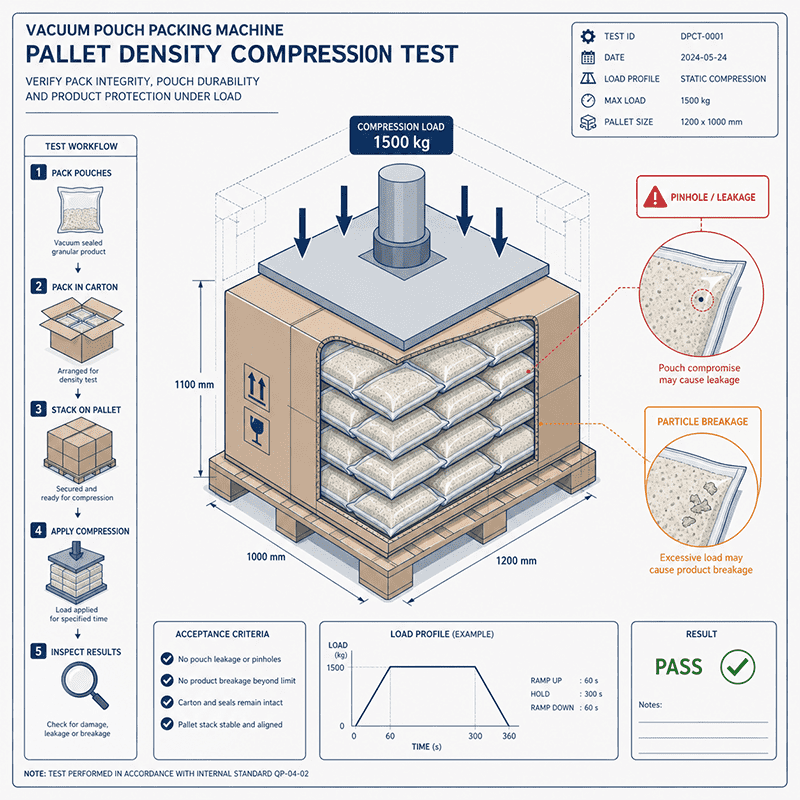
Vacuum packaging removes air pockets and can make granular products more compact. This can improve carton loading and pallet density. The limit appears when compaction damages particles or creates hard corners that rub through the film.
The industrial vacuum packaging machine should be commissioned with compression testing. If a denser package increases pinhole rate, seal stress, or broken particles, the logistics gain is not real. The correct target is stable density, not maximum collapse.
Tamper Evidence and Presentation Need Consistent Pack Shape
A tight vacuum pack can show obvious shape change if the seal is broken. That supports tamper evidence. It also presents the product clearly when the film remains smooth and the product bed is even.
Inconsistent filling weight, uneven product settling, dust in the seal area, or variable vacuum draw can create packs that look different on the same shelf. For consumer-facing granular products, visual consistency should be part of the acceptance test.
External references: ASTM F1927 oxygen transmission rate test method and FDA Packaging & Food Contact Substances.
Commissioning Checklist
Measure package volume reduction without exceeding acceptable particle breakage.
Check vacuum decay after carton compression and pallet stacking.
Confirm oxygen and moisture barrier data for the final film structure.
Inspect seal quality when normal dust and fines are present.
Record whether pack shape remains consistent enough for retail display and tamper evidence.
Contact our engineering team directly:
Email: export@jialong.cn
WhatsApp: +86-136-2579-4992
Products: granule packing machine