Vacuum Packaging Machine Compliance: Performance, Food Contact, and Safety Tests Buyers Should Verify
Vacuum Packaging Machine Compliance: Performance, Food Contact, and Safety Tests Buyers Should Verify
Published on: June 10, 2026
A vacuum packaging machine should not be judged only by chamber size, pump capacity, or quoted cycle speed. For food, pharmaceutical, electronics, and industrial packaging, the buyer needs evidence that the machine can hold vacuum performance, produce repeatable seals, protect operators, and avoid contamination from food-contact surfaces.
National standards, local regulations, and customer factory specifications may use different numbering systems. The engineering logic is similar: define measurable performance, document safety design, verify materials, and keep a maintenance record. A supplier who cannot provide test reports is asking the buyer to accept risk without evidence.
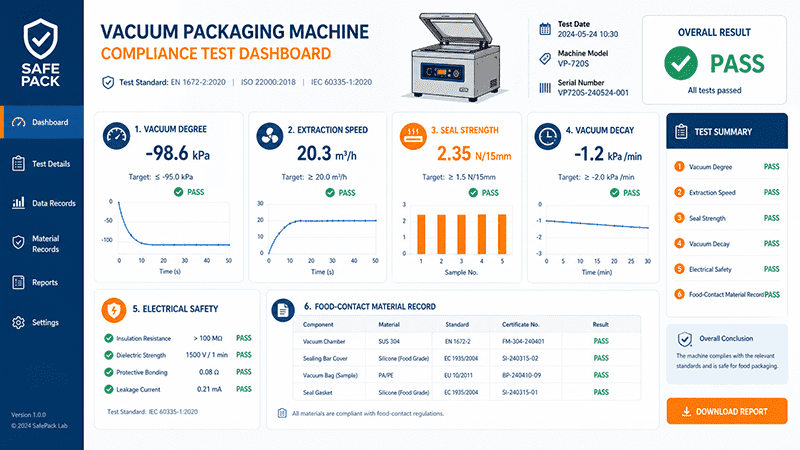
Performance Standards Start With Measurable Packaging Results
The first test is not cosmetic. A vacuum packaging machine should reach the required vacuum level, hold stable chamber pressure, and produce a seal that survives handling and storage. Vacuum decay, seal peel strength, air extraction time, chamber recovery, and repeatability across shifts are more useful than a single demonstration pack.
An automatic vacuum packaging machine also needs recipe control. Different bags, films, and products require different evacuation time, seal temperature, dwell time, cooling time, and optional gas flushing. If the PLC cannot lock or record these parameters, the line may drift even when the machine looks compliant during the factory acceptance test.
| Compliance area | What to verify | Acceptance evidence |
|---|---|---|
| Vacuum performance | Target vacuum level and extraction time | Factory test sheet from the vacuum packaging machine trial |
| Seal strength | Peel strength, wrinkle rate, and vacuum decay | Sample report by film type and product size |
| Food-contact surfaces | Stainless steel grade, seals, belts, and contact plastics | Material declaration and cleaning instructions |
| Operator safety | Guarding, emergency stop, lid safety, and moving parts | Risk assessment and inspection checklist |
Food-Contact and Hygiene Design Are Not Optional
For food packaging, material safety must cover every surface that can contact the product, the bag interior, or the operator-cleaned product path. FDA defines food contact substances as substances intended for use as components of materials used in manufacturing, packing, packaging, transporting, or holding food when they are not intended to have a technical effect in the food.
ISO 14159 addresses hygiene requirements for machinery design where hygiene risks to consumers may occur. For an industrial vacuum packaging machine, this points buyers toward cleanable chamber corners, practical belt removal, drain and residue control, and documentation for parts that contact food or packaging.
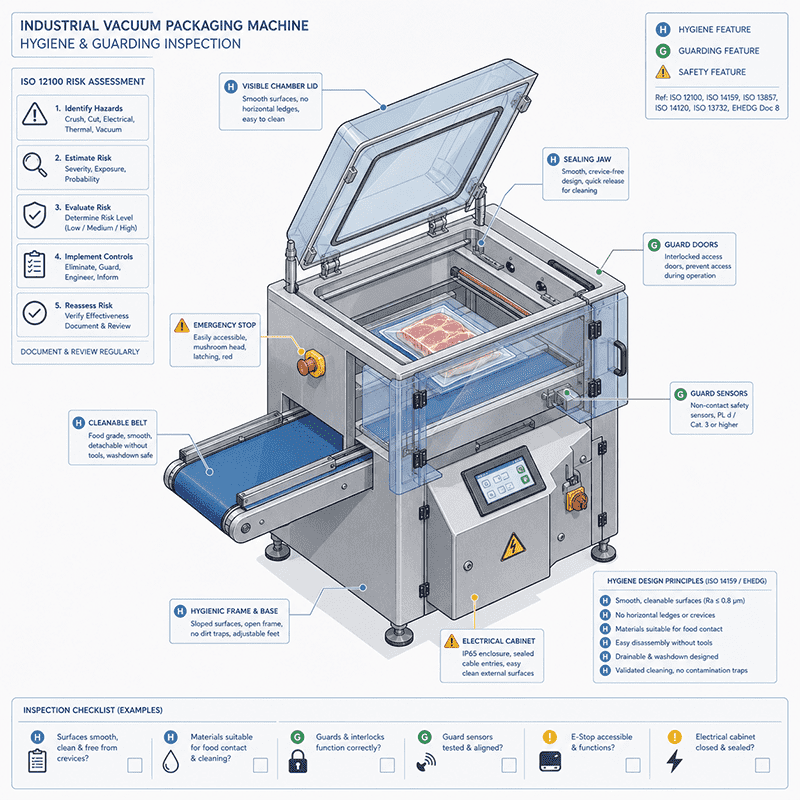
Safety Review Should Follow a Risk-Based Method
ISO 12100 provides principles for machinery risk assessment and risk reduction. A sealer vacuum packaging machine has foreseeable hazards: heated sealing jaws, moving lid or conveyor parts, pinch points, electrical cabinets, compressed air, vacuum pump heat, and cleaning access. These hazards should be identified and reduced before shipment.
The vacuum packing system should also include maintenance access. A machine that is safe only when perfectly clean will not stay compliant on a real production floor. Operators need clear procedures for changing seal wires, cleaning chambers, inspecting belts, checking pump oil, and verifying emergency stops.
External references: ISO 12100 machinery risk assessment, ISO 14159 hygienic machinery design, and FDA Packaging & Food Contact Substances.
Commissioning Checklist
Request vacuum level, air extraction time, seal strength, and vacuum decay test data.
Verify food-contact material declarations for chamber, belts, seals, and contact parts.
Check emergency stop, guarding, lid safety, electrical cabinet labeling, and mechanical stability.
Confirm cleaning access before the vacuum packaging machine is approved for production.
Keep maintenance records for pump oil, seal wires, gaskets, belts, and sensor calibration.
Contact our engineering team directly:
Email: export@jialong.cn
WhatsApp: +86-136-2579-4992
Products: vacuum packaging machine