Vacuum-Packed Nuts in 2026: Barrier Films, Nitrogen Control, and Traceable Pack Design
Vacuum-Packed Nuts in 2026: Barrier Films, Nitrogen Control, and Traceable Pack Design
Published on: June 5, 2026
A cashew nut vacuum packing machine should not be selected only by chamber size or cycle speed. Nuts contain oil, fracture easily under hard compression, and lose value when oxygen, moisture, or light exposure accelerates rancidity. The useful trend in 2026 is not decorative packaging. It is tighter process control.
Three changes matter most for vacuum-packed nuts: better barrier verification, controlled vacuum and nitrogen recipes, and packaging that can carry traceability data without weakening the seal. Each trend changes the equipment specification for a nuts packing machine.
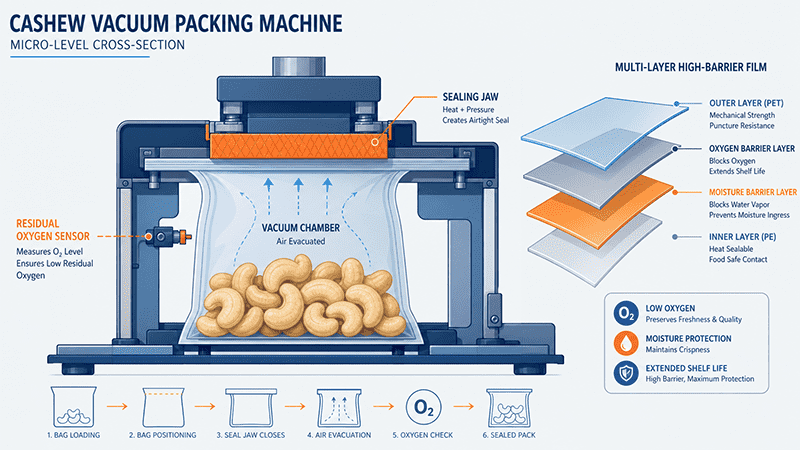
Barrier Film Selection Is Becoming a Process Decision
High-barrier films are useful only when the full structure matches the product. Cashews, almonds, walnuts, peanuts, and mixed nuts do not create the same package stress. Sharp fragments can puncture thin film. Oil can affect label adhesion and surface handling. A vacuum pouch packing machine should be tested with the final film, final pouch size, and final nut blend.
The film decision should include oxygen transmission, moisture barrier, light protection, puncture resistance, and seal window. A film that protects flavor but seals only in a narrow temperature range can create reject bags when the line speed increases. The industrial vacuum packaging machine must hold sealing temperature and dwell time inside that window.
| Trend | Risk if treated as marketing | Machine check |
|---|---|---|
| High-barrier film | Good shelf claim, poor seal window | Run the cashew nut vacuum packing machine across low and high line speed |
| PCR or recyclable material | Food-contact risk or weaker barrier | Review food-contact documents and seal strength |
| QR traceability | Code distortion after vacuum collapse | Scan test after packing, carton compression, and storage |
| Customized blends | Weight drift and cross-contact risk | Recipe control, cleaning access, and weighing accuracy |
Nitrogen Control Must Protect Texture, Not Just Residual Oxygen
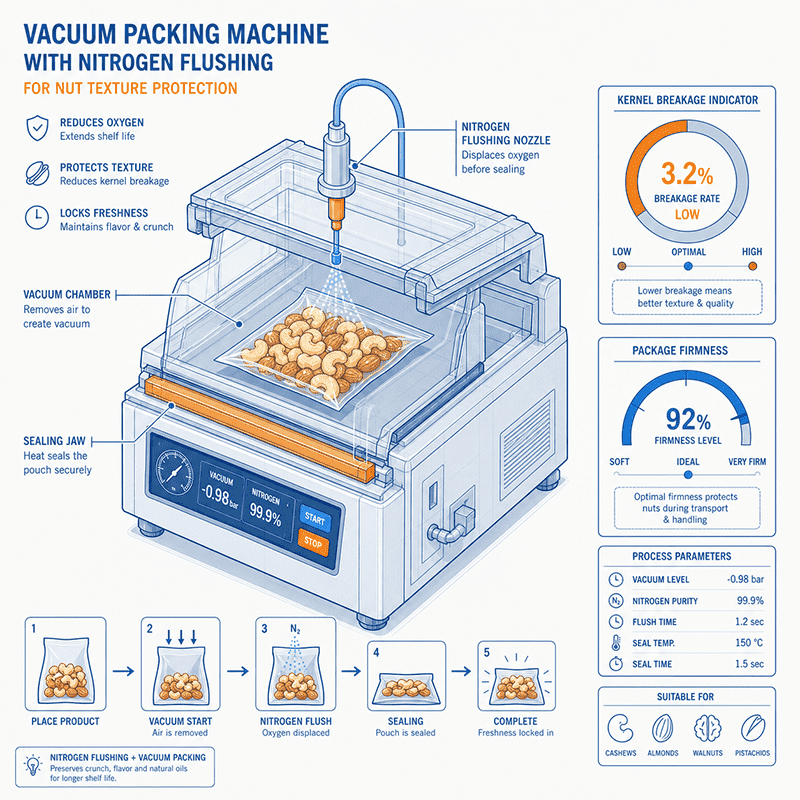
A vacuum packing machine with nitrogen flushing can reduce oxygen while avoiding the hardest vacuum collapse. That matters for brittle nuts and coated blends. If the package is pulled too hard, whole kernels can crack or coatings can abrade during handling.
The correct recipe is product-specific. Cashews may need a different vacuum and nitrogen balance than peanuts or mixed trail blends. The nuts packing machine should store recipes by product, bag size, target residual oxygen, and acceptable pack firmness.
Smart Packaging Needs Print Stability
QR codes and GS1 Digital Link can connect the package to product data, traceability information, batch details, certifications, and usage content. That does not remove the need for normal retail barcodes or clean artwork control. The real machine issue is whether the code remains scannable after vacuum collapse and carton handling.
GS1 states that Digital Link allows a single 2D barcode to connect to product information, traceability information, certifications, and other digital content. For vacuum-packed nuts, the code area should be located away from high-wrinkle zones and tested after the final pack shape forms.
Sustainability Claims Need Food-Contact Review
Recyclable structures, downgauged films, and post-consumer recycled content can be useful, but food-contact suitability and barrier performance must be verified. FDA notes that recycled plastic used in food packaging raises safety concerns around possible contaminants, source control, and compliance of additives. The packaging claim should never move faster than the material file.
For food-contact and recycled plastic review, see FDA resources on Recycled Plastics in Food Packaging and GS1 Digital Link.
Commissioning Checklist
Run the cashew nut vacuum packing machine with the final nut type, blend, pouch, and film structure.
Record residual oxygen, vacuum level, nitrogen flow, seal temperature, and package firmness.
Check whole-kernel breakage before and after packing.
Scan QR or GS1 Digital Link codes after vacuum collapse and carton compression.
Verify food-contact documentation before using PCR or recyclable film claims.
Contact our engineering team directly:
Email: export@jialong.cn
WhatsApp: +86-136-2579-4992
Products: cashew nut vacuum packing machine