Vacuum Settings for Rice Packaging: Grain Breakage, Nitrogen Cushioning, and Seal Control
Vacuum Settings for Rice Packaging: Grain Breakage, Nitrogen Cushioning, and Seal Control
Technical note for rice processors reviewing vacuum level, evacuation time, grain integrity, and package handling after sealing.
Rice vacuum packing machine selection often starts with oxygen removal, but oxygen is not the only failure mode. Highly polished rice has lower surface roughness and more brittle edges than brown rice or parboiled rice. When evacuation time is stretched too far, the bag collapses into a rigid block and the grains carry point loads against each other.
That load path is mechanical, not cosmetic. Broken grains absorb water faster during cooking, so the customer sees a softer texture and more surface starch. The same package may still pass a vacuum decay test while failing the eating-quality expectation. Seal integrity and grain integrity must be checked together.
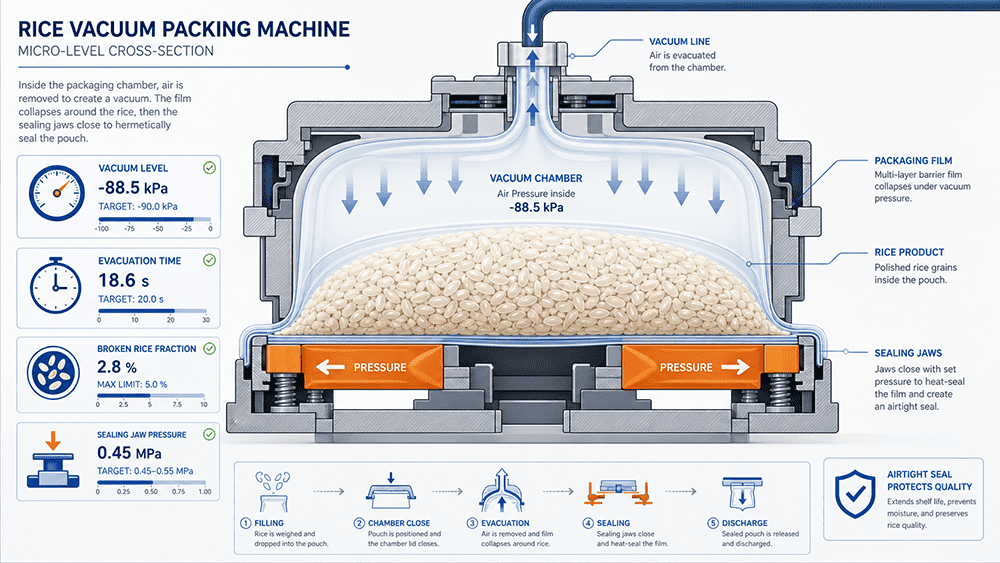
Where Grain Breakage Starts
A rice vacuum packaging machine should be commissioned with product-specific curves. Indica, japonica, fragrant rice, and brown rice do not tolerate the same pressure profile. A line that runs 5 kg bags at a stable shape may damage 1 kg retail bricks because the contact area, film stiffness, and grain bed thickness change.
The practical test is simple. Pull samples from the first 30 minutes after a setting change, sieve the broken-rice fraction, cook a small batch, and compare water uptake. If the broken fraction rises while vacuum decay remains acceptable, the vacuum curve is too aggressive for that rice grade.
| Process item | Risk if ignored | Engineering check |
|---|---|---|
| Vacuum level | Grain crushing in polished rice | Set the rice vacuum packing machine by rice variety and package size |
| Evacuation time | Hard brick shape and sharp corners | Record the curve before setting the final dwell time |
| Nitrogen backfill | Flat pack with poor cushioning | Use a vacuum packing machine with nitrogen flushing for premium rice formats |
| Seal jaw pressure | Micro leak or film thinning near the edge | Validate with peel test and vacuum decay test |
Nitrogen Is a Cushion, Not a Shortcut
Premium rice packs often benefit from partial evacuation followed by nitrogen flushing. The goal is not to leave the pack loose. The goal is to reduce oxygen exposure while leaving enough internal cushion to prevent grain-to-grain compression during handling.
A vacuum packing machine with nitrogen flushing must still control residual oxygen, sealing temperature, and indexing stability. If nitrogen flow is unstable, the bag shape will drift and the sealing jaw may catch film wrinkles. On larger bags, the effect appears as one corner that remains soft while another corner becomes over-compressed.
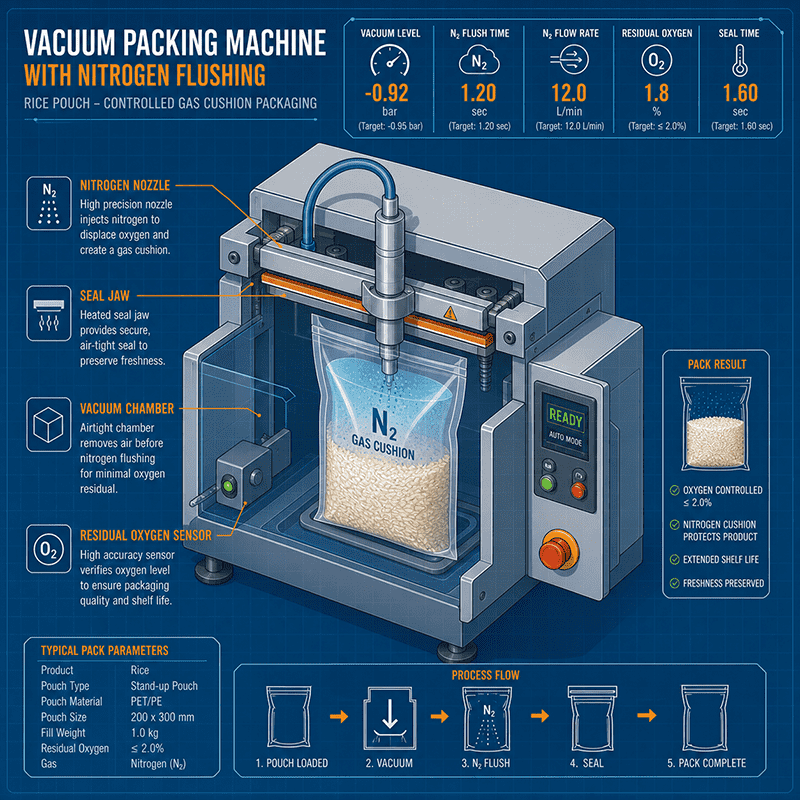
Bag Shape and Resealing Need Earlier Decisions
Rigid brick packs are efficient for transport, but the same stiffness can reduce shelf handling and consumer convenience. A gusseted pouch, back-sealed pouch, or zipper-ready film changes the way air leaves the product bed. These options should be chosen before the industrial food vacuum packaging machine is ordered, because the forming path and sealing area change.
Food-contact material selection also matters. FDA guidance treats food packaging materials as food contact substances when they contact food and are not intended to affect the food itself. Film, zipper, valve, ink, and adhesive choices should be reviewed as one package system, not as separate purchasing items. See the FDA overview of Packaging & Food Contact Substances.
Commissioning Checklist
Run the rice vacuum packing machine at three vacuum levels and compare broken-rice fraction after packing.
Check cooked texture after the package has rested for at least 24 hours.
Use a rice bag sealing machine peel test to confirm that lower vacuum pressure has not weakened the seal.
Confirm whether the retail channel needs brick shape, gusseted shape, zipper opening, or a separate clip.
Record residual oxygen, seal temperature, dwell time, and bag stiffness in the same inspection sheet.
FAQ
Can one vacuum setting run all rice varieties?
No. A rice vacuum packing machine should use recipes by variety, package weight, film gauge, and target bag shape. One rice vacuum packing machine setting may protect long-grain rice but damage polished short-grain rice.
Does nitrogen flushing replace vacuum packaging?
No. Nitrogen flushing is a controlled gas step after evacuation. It protects shape and reduces oxygen, but it still depends on seal quality and residual oxygen checks.
When should a zipper be added?
A zipper is useful when the pack size is larger than one cooking cycle. The zipper must be compatible with vacuum collapse, seal jaw clearance, and food-contact requirements.
Contact our engineering team directly:
Email: export@jialong.cn
WhatsApp: +86-136-2579-4992
Products: rice vacuum packing machine