What Poultry Mills Overlook on a Feed Packing Machine
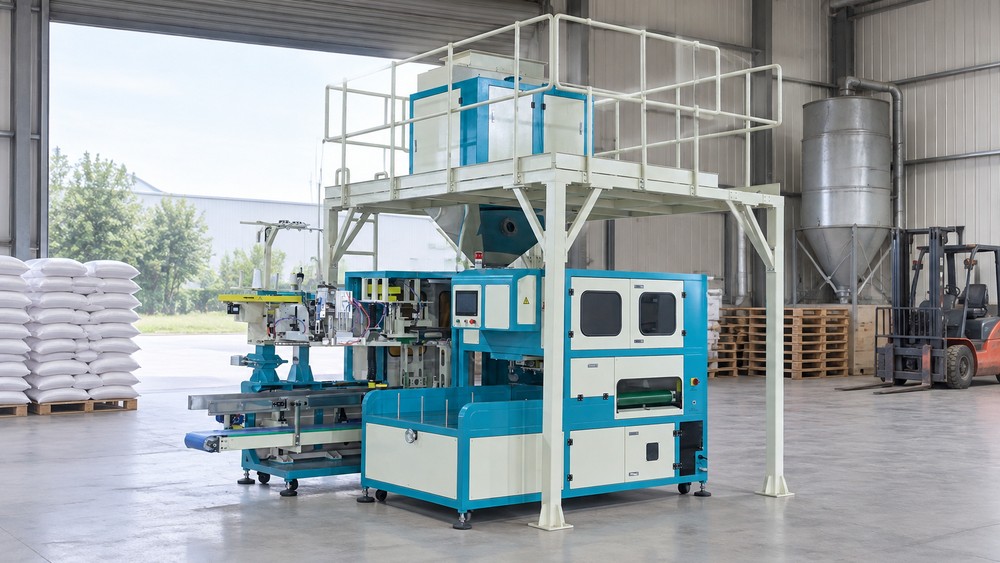
A poultry feed mill packs between 15 and 25 tonnes a day, six days a week, and almost all of it leaves in 40 kg woven bags. The feed packing machine is therefore not a precision instrument. It is a workhorse that has to survive dust, abrasion and a night shift, and it is bought by people who compare it against a rice line that never had to do any of that.
Three things change when the product is feed rather than grain. A poultry feed packing machine for 40 kg bags has to be sized on bulk density, sealed against fat, and specified for the average week rather than the peak. Most quotations sent to poultry mills are written for grain mills with a different line item, and the gap only shows in the first quarter.
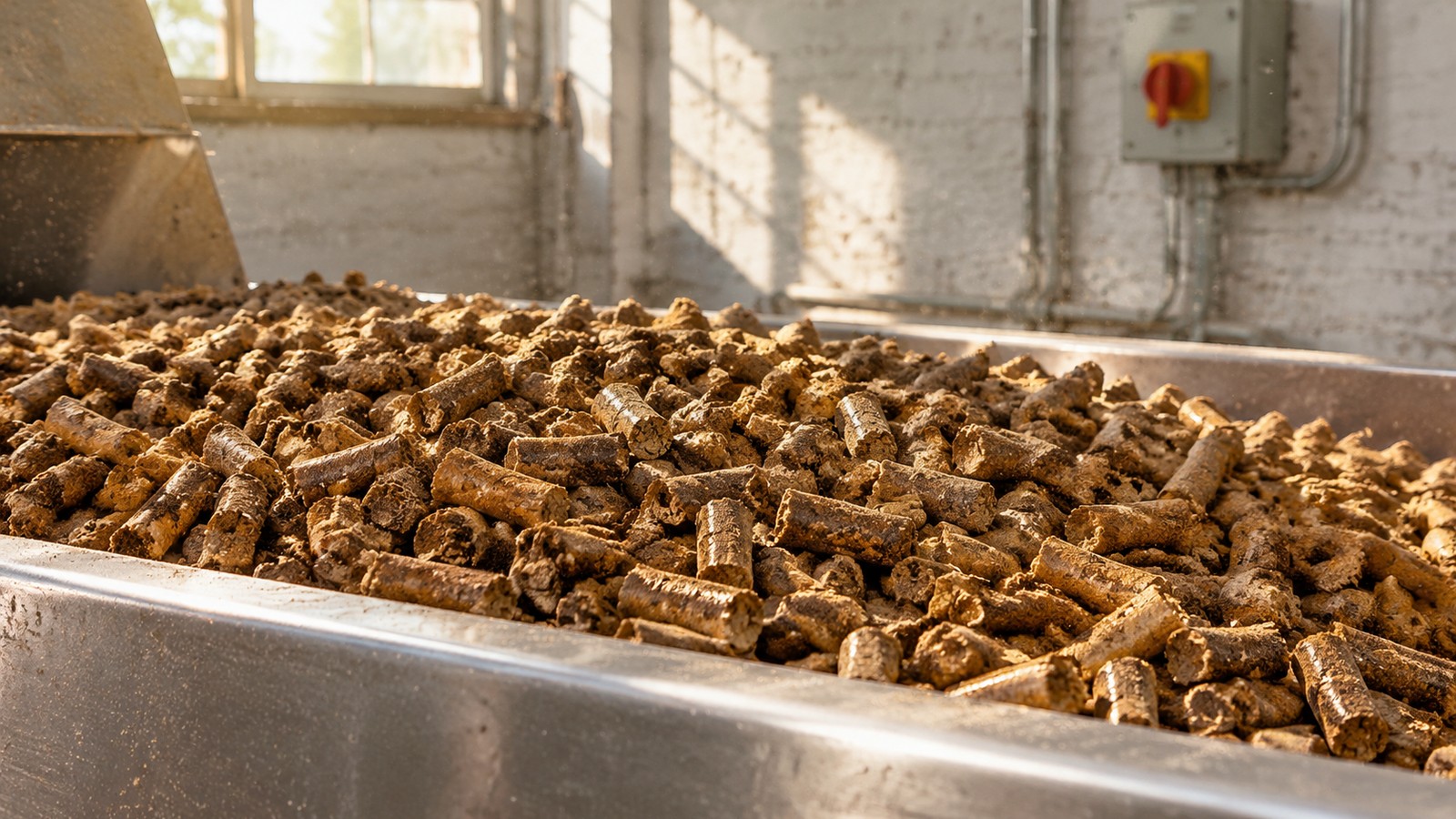
Feed pellets heaped in a stainless trough at the mill, the material whose bulk density decides the filling chamber.
Bulk density is not the number in the catalogue
Poultry mash sits around 600 kg per cubic meter, pellets at 650 to 700, crumbles somewhere between. The same forty kilo bag is a different volume in each. An automatic poultry feed packing machine for 40 kg bags sized on a generic 700 will overfill mash, cycle slowly on pellets, and hand the operator the blame for both.
Ask for the hopper and the filling chamber sized on your product's bulk density, measured rather than assumed, and ask the same question of every automatic poultry feed packing machine on the shortlist. A poultry feed bagging machine that runs pellets at 70 percent of its rated speed is usually not underpowered. It was sized on the wrong number, and nobody wrote that number down.
Dust is the maintenance item nobody quotes
Feed dust is finer than grain dust and it carries oil, so it sticks. It coats the load cells, bridges in the hopper, and works into every bearing within reach of the spout.
The automatic poultry feed packing machine for 40 kg bags needs three things a grain machine does not: an extraction hood over the spout rated for the air the bag displaces, lip seals instead of felt on the moving parts, and a clean-down that takes ten minutes.
A poultry feed bagging machine bought without the hood is a poultry feed bagging machine bought twice. If clean-down takes an hour it will not happen at all. Mills that skip the hood buy load cells every eighteen months, and the cells are the cheap part of that bill. The two days of downtime are not.
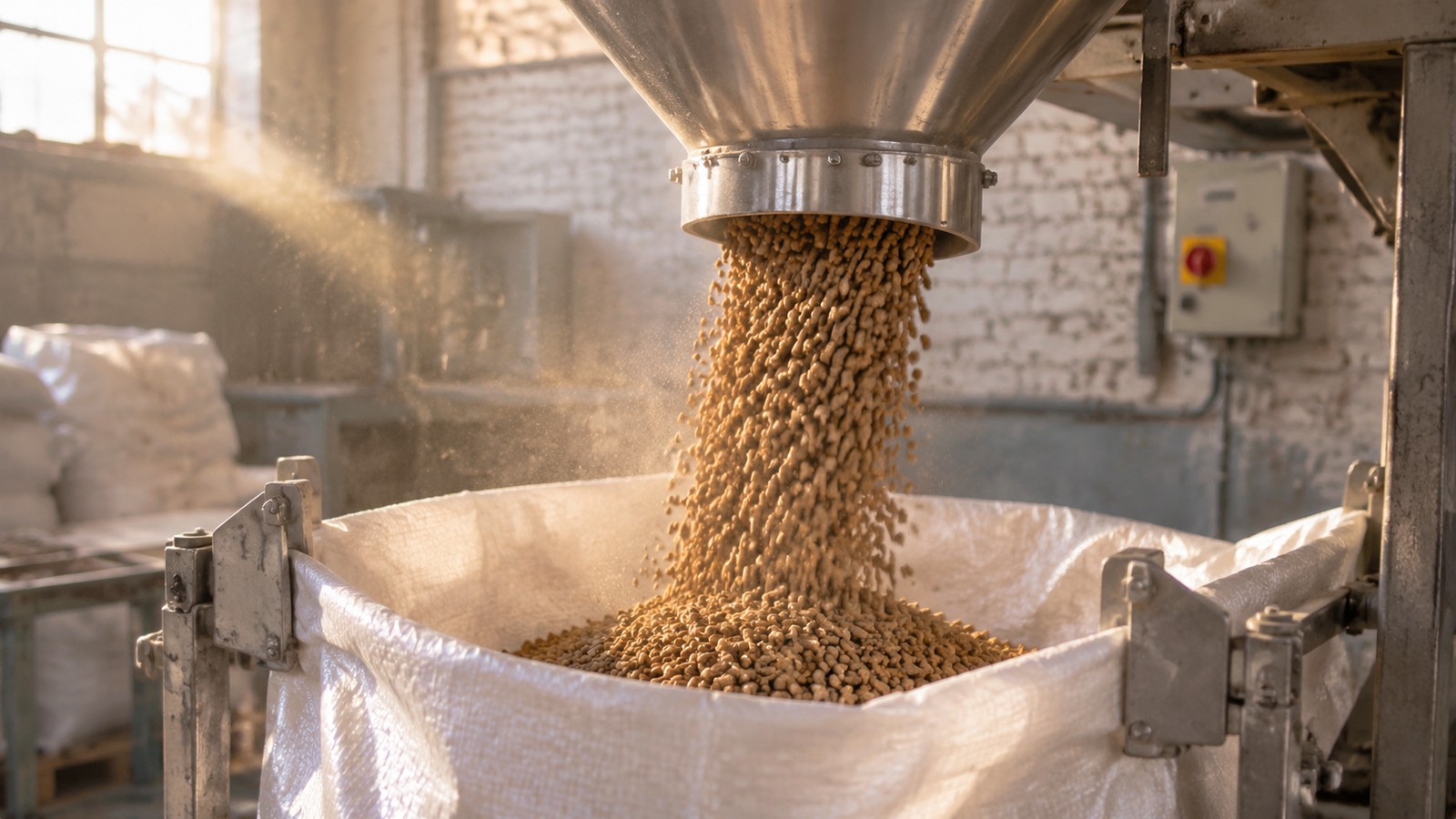
Pellets falling from the discharge spout into a woven sack, the point where feed dust starts to coat the load cell.
Fat attacks the seals, not the steel
Feed carries 3 to 6 percent fat, and in pelleted feed some of it sits on the surface as a coating. That film attacks natural rubber and standard nitrile, and a seal that lasts three years on rice lasts nine months on feed.
Buyers who ask what the seals are made of are asking a better question than buyers who ask for the price. Specify polyurethane or Viton on the spout seals and the chamber seals, and accept the small percentage it adds to the price in exchange for a failure that leaves the plan. It is the single cheapest change a poultry feed bagging machine can carry.
The same film is why an automatic poultry feed packing machine should be brushed down and vacuumed, not hosed. Water drives the fat into the seams and the seams are where a feed bag fails.
Size for the average week, not the peak
Demand rises before a flock placement and falls after it. Sizing the feed packing machine for the peak means running at 40 percent of capacity for most of the year, which is the worst duty a weigher can be given, because the mechanism wears without producing anything. Size the poultry feed bagging machine for the average week and add a shift when the peak arrives.
Two shifts on a 600 bag per hour machine beat one shift on a 1,200 bag per hour machine. The second machine earns for three months and depreciates for twelve, and the crew that runs it is the crew you already have.
The forty kilo bag sets the clamp
Laminated woven PP at forty kilos is heavier than a rice bag of the same nominal weight. The clamp needs more pressure, the sewing head a larger needle, and the thread a heavier count. Ask for a demonstration on the automatic poultry feed packing machine for 40 kg bags, with your bag, your product and your target weight, and watch the clamp rather than the scale.
Feed bags fail at the seam more often than rice bags do, and the failure usually starts as clamp slip wearing a sewing problem's clothes. On a poultry feed bagging machine the clamp pressure is the number to log, not the thread tension.
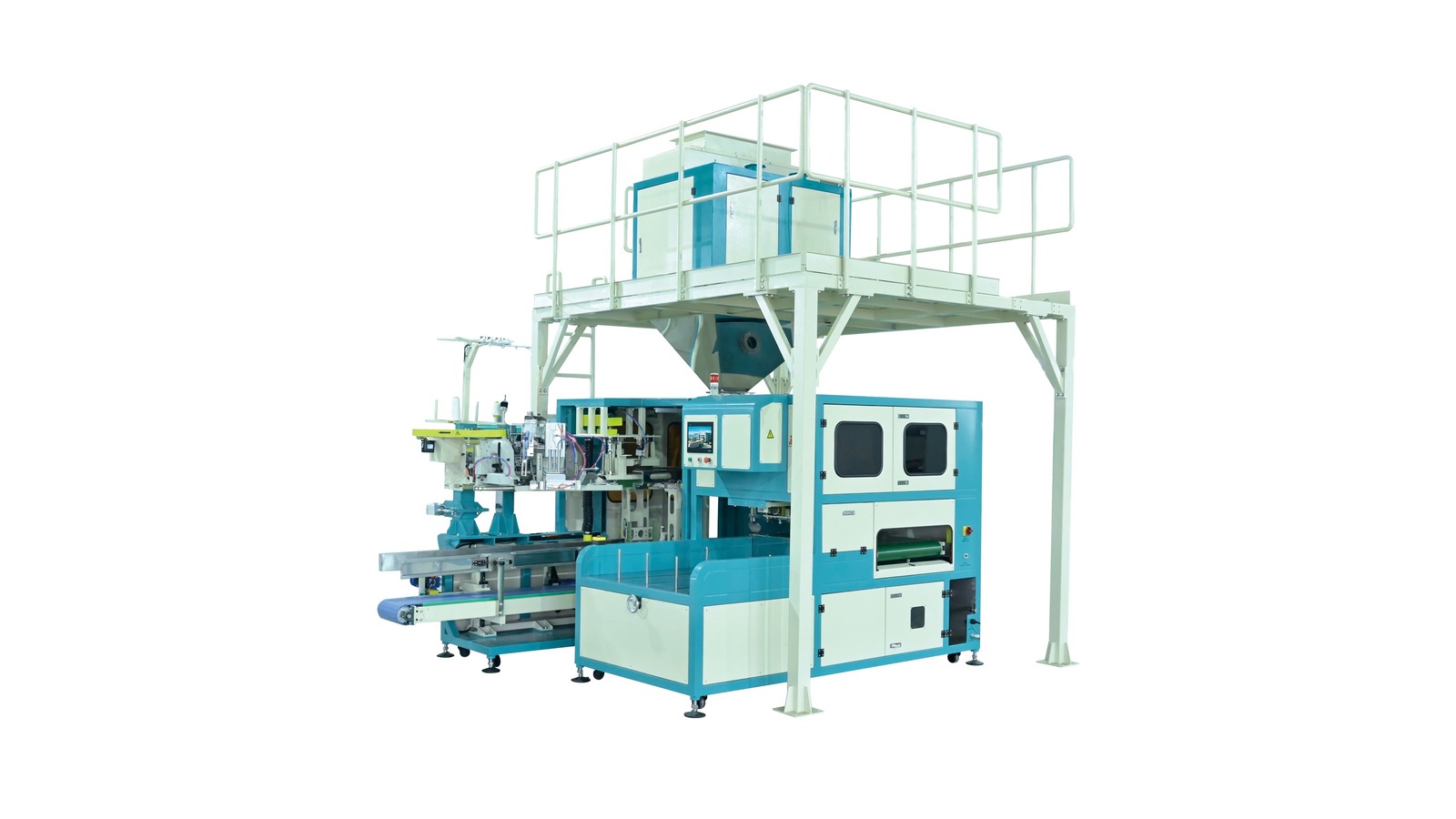
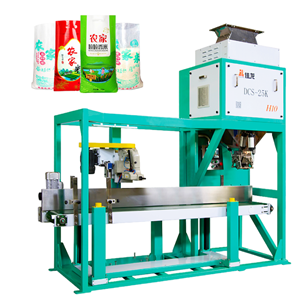
White-background bagging scale with hopper, weighing head, sewing head and takeaway conveyor on one frame.
What the first month tells you
Weigh ten bags at the end of the morning shift and ten at the end of the afternoon, then compare the spread. A poultry feed bagging machine that drifts between shifts is telling you the dust is already inside the load cell or the product temperature is moving the flow. Both are fixable in week one. Neither is fixable in month six, when the seller has stopped answering the phone.
The hopper angle nobody checks
Every automatic poultry feed packing machine has a hopper angle, and almost no quotation states it. Mash bridges at about sixty degrees, crumbles at sixty-five, pellets do not bridge at all. A feed packing machine sold for a mash line with a sixty degree hopper will bridge every humid morning and the mill will blame the product.
Ask for the angle in writing. A mill running mash and pellets on one frame needs the mash angle, the steeper one, plus a vibrator driven on a duty cycle rather than a fixed amplitude.
What to put in the enquiry
Four numbers answer most of it: the daily tonnage you actually ship, the bulk density of your densest and your lightest product, your bag dimensions and nominal weight, and the air supply at the wall. With those, a poultry feed packing machine for 40 kg bags can be quoted against your line instead of a brochure, and the quotation has a chance of surviving the first humid week.
Zhangzhou Jialong Technology Co., Ltd. builds the feed packing machine and the poultry feed bagging machine on one frame in Zhangzhou, and quotes an automatic poultry feed packing machine for 40 kg bags from those four numbers rather than from a catalogue. The bagging range sits at https://jialong-packing.com/, and export@jialong.cn or +8613806951676 will answer with a written figure, a hopper angle and a seal specification.
If a mill sends only the tonnage, the reply is a range. Send the density and the bag and the reply becomes a machine, a hopper angle and a spare parts list that a poultry feed packing machine for 40 kg bags can actually be maintained against.