The Packaging Science Behind Crispy Vacuum-Dried Nuts
The Packaging Science Behind Crispy Vacuum-Dried Nuts
Published on: March 16, 2026 | By Jialong Engineering Desk
You spent weeks calibrating the vacuum dryer. Temperature curves dialed in. Vacuum levels held stable. Dehydration endpoints hit precisely. Your nuts come out crispy, golden, and chemically intact. Then a worker bags them in a standard single-layer PE film, seals it with a basic impulse sealer, and ships the pallet to a distributor warehouse in Southeast Asia. Six weeks later, your premium nuts taste like damp cardboard. That is not a drying problem. That is a packaging failure. The vacuum packaging machine for nuts deployed after the dryer determines whether all that upstream precision was commercially worth anything.
The snack industry obsesses over the drying step. Vacuum, temperature, dehydration endpoints — these get all the engineering attention. The packaging step gets treated as a logistical afterthought. That is an expensive mistake. Vacuum-dried nuts are among the most chemically unstable food products you can put into a bag. Understanding exactly why demands a look at what dehydration does to nut tissue at a molecular level.
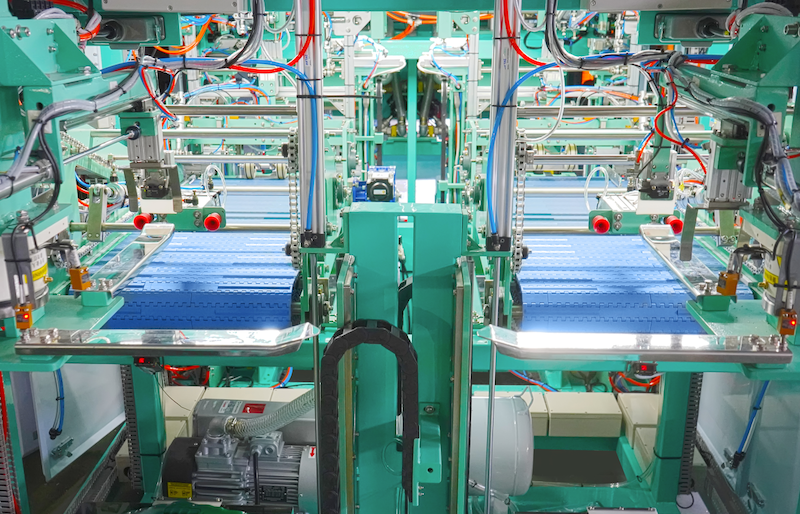
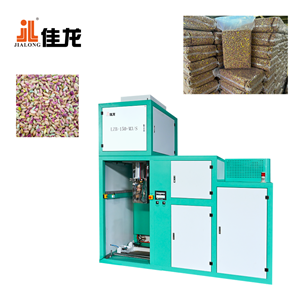
Figure 1: Precision thermal seal jaws and extraction manifolds — the two components that determine nut packaging shelf life.
A fresh walnut contains enough bound water to act as a natural buffer between its lipid-rich tissue and the surrounding oxygen. Remove that water through vacuum drying — down to 2–3% residual moisture — and that buffer is gone. The unsaturated fatty acids sitting inside the nut are now directly exposed to whatever atmosphere your packaging creates. Linoleic acid in walnuts. Oleic acid in almonds. These compounds oxidise rapidly under oxygen exposure. The result is rancidity. That stale, bitter, almost paint-like aftertaste that destroys repeat purchase rates.
This is where oxygen barrier film stops being a marketing term and becomes a hard engineering specification. Lipid oxidation in high-fat dried nuts accelerates sharply above 1% residual oxygen concentration. A barrier film for dried nuts with an oxygen transmission rate (OTR) above 10 cc/m²/day will allow enough oxygen permeation to turn a premium walnut rancid in under 60 days at ambient temperature. For a product retailing at premium pricing with a 12-month expected shelf life, that is commercially catastrophic.
The second failure mechanism is moisture reabsorption. Dehydrated nut tissue is aggressively hygroscopic. Without a verified seal, ambient humidity drives water vapour back into the product within days. The crispness your dryer created — that precise snap that justifies the premium price — disappears. You end up with a limp, chewy product that no amount of branding can rescue once it reaches the consumer. Controlling moisture vapour transmission rate (MVTR) through your barrier film for dried nuts is as non-negotiable as controlling vacuum depth in the dryer itself.
Two dominant methods exist for removing oxygen from nut packaging. Both have genuine applications. Choosing the wrong one for your product and supply chain costs you either in product quality or in operational complexity — sometimes both.
Pure vacuum extraction using a vacuum packaging machine for nuts pulls residual oxygen down to 0.5% or below. The film collapses tightly around the product. The result is structural rigidity — pallets stack cleanly, units survive rough freight handling, and the dense brick profile communicates quality at the retail level. The technical concern is mechanical fragility. Cashews and macadamias have angular geometry. Under full compression force, thin film can puncture at contact points. This is not an argument against vacuum packaging. It is an argument for specifying the correct film gauge and using a vacuum packaging machine for nuts with adjustable extraction pressure and controlled compression speed.
Nitrogen flushing replaces oxygen with inert gas rather than evacuating atmosphere entirely. The bag retains slight inflation. Oxygen control is excellent when seal integrity holds. The weakness is long-transit seal reliability. Any micro-failure in the thermal seal — a cold spot, a contamination particle, a 0.5mm gap — allows nitrogen to escape and ambient air to enter. These failures are invisible at packing but catastrophic at point of sale. For export routes covering 30 to 60-day ocean freight timelines, deep vacuum extraction consistently outperforms nitrogen flush on product integrity metrics.
High-performance operations deploy a hybrid approach: vacuum extraction followed by nitrogen back-fill to a controlled residual oxygen level between 1–2%. This method, available on advanced vacuum packaging machine for nuts models, achieves both structural compression and inert atmosphere protection simultaneously. The nut packaging shelf life achievable under this method — for correctly dried almonds and cashews — reliably exceeds 18 months under normal ambient storage conditions.
A barrier film for dried nuts is not a commodity procurement decision. It is a precision component in the preservation system. The minimum viable specification for vacuum sealed nut packaging targeting a 12-month shelf life is a co-extruded multi-layer laminate with the following verified properties: OTR below 5 cc/m²/day at 23°C and 0% RH. MVTR below 3 g/m²/day at 38°C and 90% RH. Total film thickness between 90 and 120 microns depending on nut geometry and expected mechanical stress in transit.
The structure that achieves these numbers is not complicated, but every layer is load-bearing. The outer layer is biaxially oriented nylon — BOPA — for puncture resistance and print surface quality. The core layer is EVOH, ethylene vinyl alcohol copolymer, which is the actual oxygen barrier. The inner contact layer is cast polypropylene or LLDPE, selected for thermal seal strength and food-safe compliance. Substituting any of these layers with a cheaper alternative is a direct attack on your nut packaging shelf life.
Running this film specification through a vacuum packaging machine for nuts that cannot maintain seal jaw temperature within ±2°C uniformity across the full seal width defeats the entire engineering above it. The seal zone is the lowest-barrier point in the whole system. One cold spot creates a moisture ingress channel that bypasses every layer of EVOH above it. Seal jaw thermal consistency is not a comfort feature. It is the primary quality control metric.
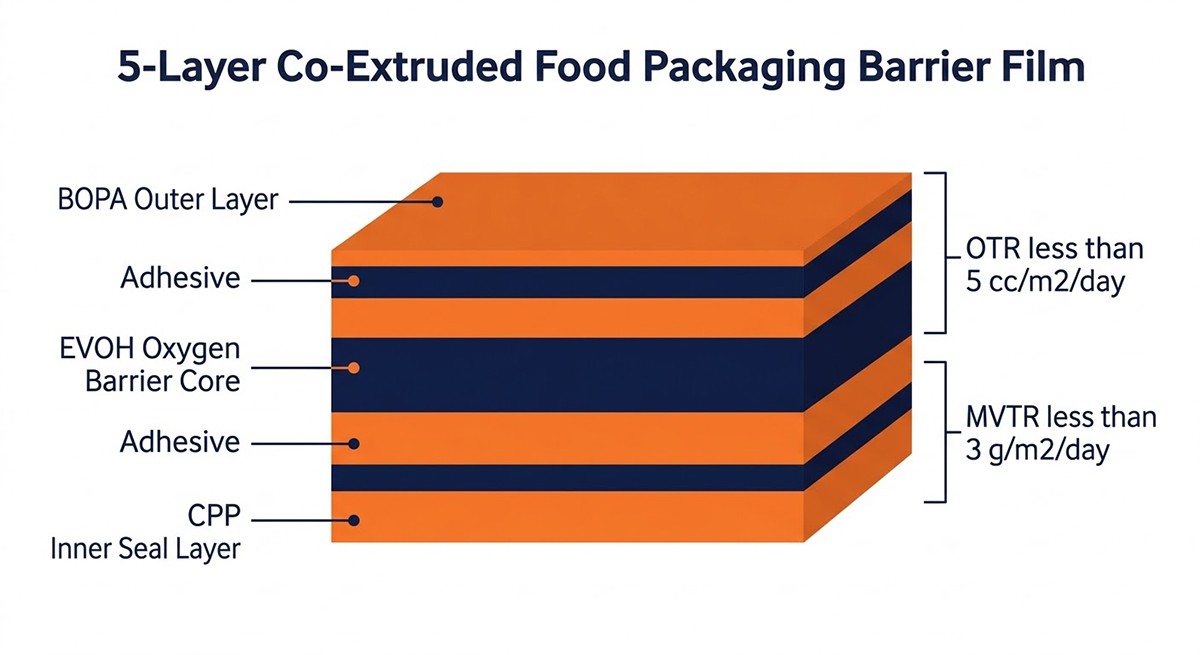
Figure 2: Co-extruded barrier film cross-section — BOPA outer / EVOH oxygen barrier core / CPP inner seal layer.
The Engineering Reality Check
A budget impulse sealer and single-layer PE film cannot extend nut packaging shelf life beyond 60 days. That is not an opinion. It is chemistry. Lipid oxidation and moisture reabsorption in vacuum-dried products do not wait for your logistics timeline. Without verified OTR control and seal integrity validation, your premium dried nuts begin degrading the moment they leave the dryer chamber.
Jialong designs vacuum packaging machine for nuts systems with anti-fragmentation extraction manifolds that protect delicate nut geometry under full vacuum load, precision-controlled thermal seal jaws calibrated to ±1.5°C across the seal width, and full compatibility with co-extruded barrier film for dried nuts across all major laminate specifications. When our extraction technology is paired with correctly specified oxygen barrier film, the hermetic environment inside each bag holds for the full commercial shelf life your brand requires — whether that is 12 months on domestic shelves or 18 months in global export chains.