Why Vacuum-Tumbled Legumes Go Mushy: The Engineering Parameters That Decide Texture
Why Vacuum-Tumbled Legumes Go Mushy: The Engineering Parameters That Decide Texture
Published on: March 27, 2026 | By Jialong Engineering Desk
A vacuum tumbling machine for legumes that runs aggressive extraction cycles does not produce premium marinated chickpeas. It produces mush. The cellular structure of a legume — the pectin matrix holding the cotyledon tissue together — responds to rapid pressure change the same way it responds to overcooking: it collapses. Bean texture preservation in legume vacuum tumbling is not a raw material quality issue. It is a vacuum pressure cycle control problem. The machine parameters decide whether a batch of chickpeas comes off the line with the firm, al dente bite that justifies premium positioning — or ends up in a returns claim from a retailer who cannot sell soft, split-skin product.
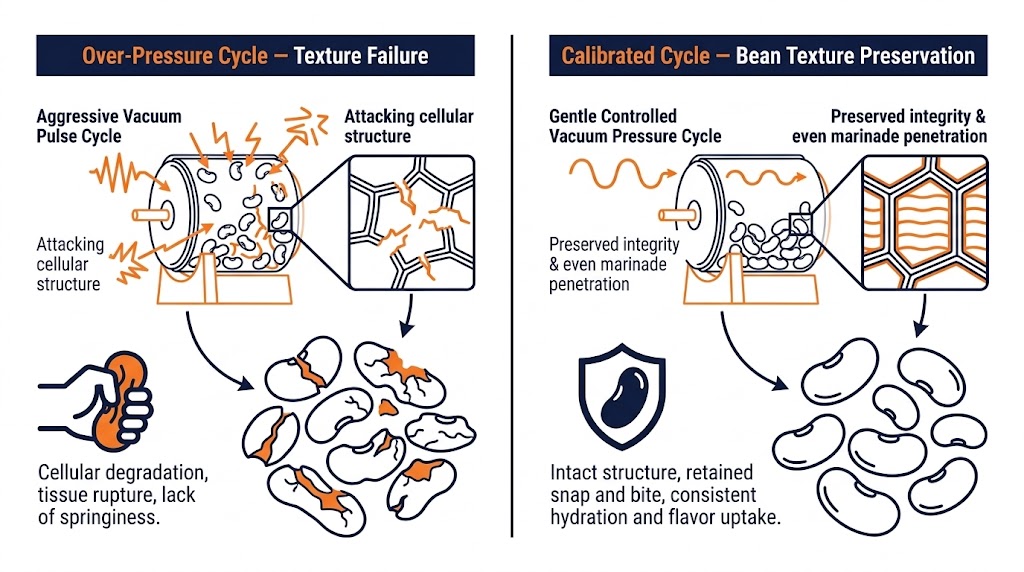
Figure 1: Aggressive vacuum pressure cycle versus calibrated cycle — the parameter difference that separates bean texture preservation from batch texture failure.
Chickpea and edamame cotyledon tissue is held together by a pectin-based cell wall matrix. Under rapid vacuum extraction — a pressure drop from atmospheric to below 10 kPa in under 5 seconds — the internal cell fluid expands faster than the pectin matrix can accommodate. Cell walls rupture. The bean loses its structural integrity before the marinade cycle even begins. The result is a soft, waterlogged texture that no amount of downstream processing can recover. Bean texture preservation in legume vacuum tumbling starts with vacuum pressure cycle control that respects the mechanical limits of the cell wall matrix — not the fastest extraction setting the marinated bean processing machine can achieve.
The correct legume vacuum tumbling approach uses a staged extraction profile: initial pressure drop to 30–40 kPa over 8–12 seconds, hold phase to allow cell equilibration, then secondary extraction to target depth. This staged vacuum pressure cycle control allows the pectin matrix to adjust progressively rather than catastrophically. Skin splitting — the visible failure mode that makes vacuum-tumbled chickpeas unsaleable at retail — drops dramatically when the vacuum tumbling machine for legumes is programmed to a multi-stage pressure profile rather than a single aggressive extraction pulse.
Uniform flavour penetration in legume vacuum tumbling fails for a specific hydraulic reason. Standard high-flow marinade injection saturates the surface layer and inter-bean void spaces before the seasoning liquid has time to diffuse into the dense cotyledon core. The exterior of the chickpea reaches salt equilibrium in minutes. The core remains bland. This hollow bean effect is not a formulation problem — it is a marinated bean processing machine flow rate problem.
The engineering fix is low-flow multi-point injection combined with controlled tumbling frequency. A vacuum tumbling machine for legumes with independently programmable injection flow rate — targeting 0.8–1.2 ml per bean per cycle — distributes marinade volume at a rate the cotyledon tissue can absorb rather than pool around. Subsequent gentle oscillation at 4–6 rpm mechanically works the seasoning into the bean matrix without applying the shear force that damages surface texture. Vacuum pressure cycle control during the tumbling phase maintains the osmotic gradient that drives diffusion inward — holding the internal bean pressure slightly below atmospheric forces the marinade to migrate toward the core rather than stay on the surface. This is the legume vacuum tumbling parameter combination that eliminates the hollow bean effect from batch production.
Bean texture preservation and uniform flavour penetration are not competing engineering goals in a correctly designed vacuum tumbling machine for legumes. Staged vacuum pressure cycle control protects structure during extraction. Low-flow injection and controlled tumble frequency drive marinade to the core without mechanical damage. A marinated bean processing machine built around programmable multi-stage cycles delivers both outcomes from the same production run — without the operator trade-offs that poorly specified legume vacuum tumbling equipment forces on every batch.
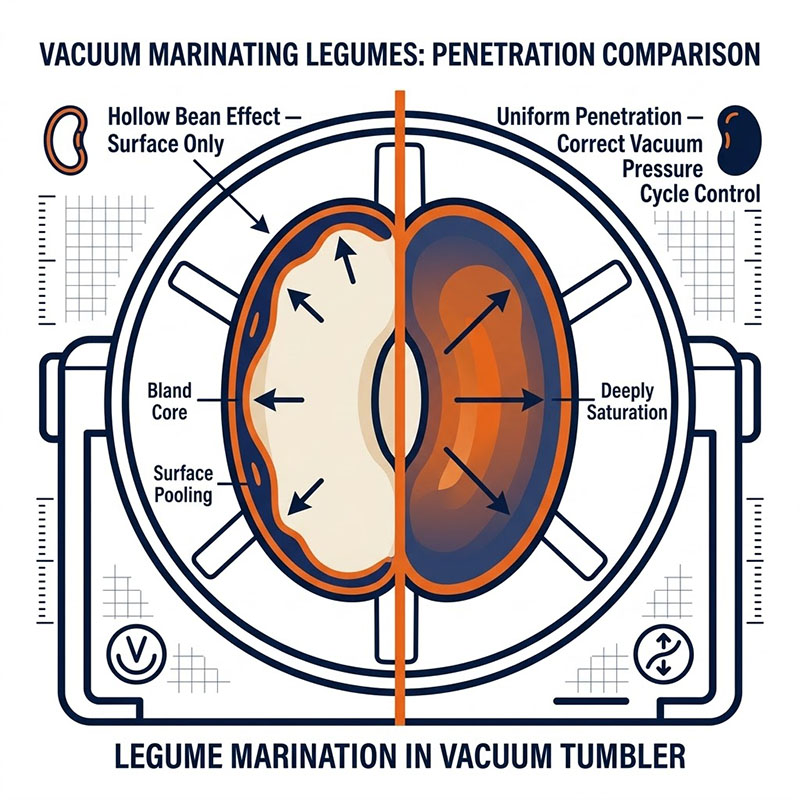
Figure 2: Hollow bean effect versus uniform penetration — the injection flow rate and vacuum pressure cycle control parameters that decide which outcome your marinated bean processing machine delivers.
The Engineering Verdict
Texture failure and hollow bean flavour in vacuum-tumbled legumes are both solved at the equipment parameter level — not the raw material or formulation level. A vacuum tumbling machine for legumes with programmable multi-stage vacuum pressure cycle control, independently adjustable injection flow rate, and controlled tumble frequency delivers consistent bean texture preservation and uniform marinade penetration from the first batch to the thousandth. Legume vacuum tumbling done correctly is a repeatable engineering process. It requires a marinated bean processing machine built to control every variable that decides the outcome.