Vacuum-Packed Legumes: Shelf Life, Moisture Control, and Packaging Value
Vacuum-Packed Legumes: Shelf Life, Moisture Control, and Packaging Value
Published on: July 1, 2026
Legumes are naturally dry and stable, but they still lose quality when oxygen, humidity, insects, and foreign odors reach the product over time. Vacuum packaging helps reduce those risks by lowering oxygen exposure and sealing the product inside a stronger barrier pouch.
For beans, lentils, chickpeas, and similar products, moisture control is especially important. If the pouch allows moisture gain, the product can clump, change texture, or become harder to process and sell. A stable barrier helps maintain appearance and handling quality.
Vacuum packaging also supports cleaner storage and transport. A compact pack stacks more consistently, and the sealed structure reduces dust, pantry-pest risk, and odor transfer during distribution. That is useful for both retail and export channels.
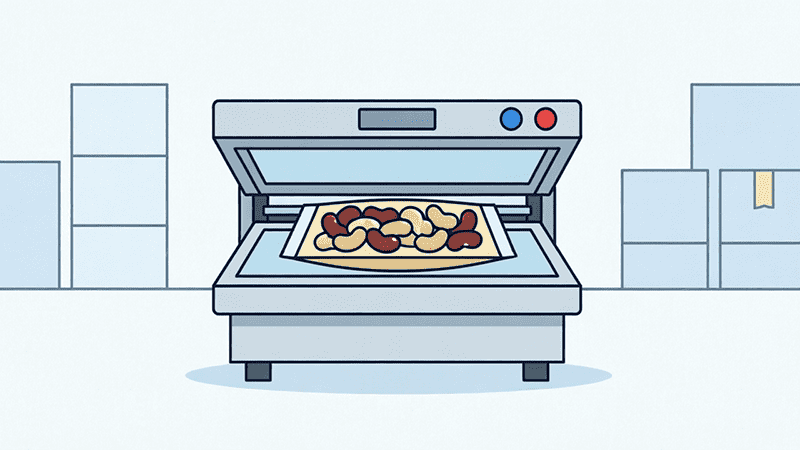
The commercial value of vacuum-packed legumes is often clearest after the product leaves the factory. Retailers want packs that stay tidy on the shelf. Distributors want packs that stack well in cartons and do not create excess dust during handling. End buyers want a bag that opens to a product that still looks clean, dry, and saleable. A good package supports all three expectations at once, which is why legumes are often a practical fit for vacuum packaging rather than a cosmetic one.
Different legumes also behave differently in the bag. Large chickpeas, small lentils, mixed bean products, and split pulses do not settle in exactly the same way. Some create more particle movement, some place more pressure on corners, and some are more sensitive to visual breakage. That means the package format and vacuum setting should be chosen with the real product in mind. A line that works well for one pulse category may need a different bag structure or different pack firmness for another.
Moisture management before sealing remains just as important as the vacuum step itself. If product condition is already drifting before packing, the machine cannot fully correct that problem later. Teams should therefore treat product preparation, pouch selection, and final sealing as one connected process. When those parts are aligned, the pack is more likely to hold shape, resist leakage, and keep the legumes in a usable condition through storage.
There is also a practical packaging question after the bag reaches the market: how predictable is the product when opened? Buyers remember consistency. If one lot opens cleanly and another shows loose dust, uneven pack shape, or signs of moisture pickup, confidence drops quickly. That is why good legume packaging is not just about extending nominal shelf life. It is about delivering the same basic experience from one shipment to the next.
Processing teams should still check final moisture, film barrier, seal strength, and package integrity after handling. The right result is not only longer storage, but more consistent product condition when the bag is opened. In day-to-day operations, that kind of consistency usually matters more than chasing the tightest possible vacuum number.
Contact our engineering team directly:
Email: export@jialong.cn
WhatsApp: +86-136-2579-4992
Products: vacuum packaging machine