Why Granular Foods Punish a Weak Vacuum Stage Most
A vacuum packaging machine that behaves perfectly on coffee blocks can struggle the day it meets brown rice. Granular products are not simply another SKU: they carry air between particles, shed dust at exactly the wrong place, and resist compression in ways that stress equipment. Three failure modes concentrate the trouble.
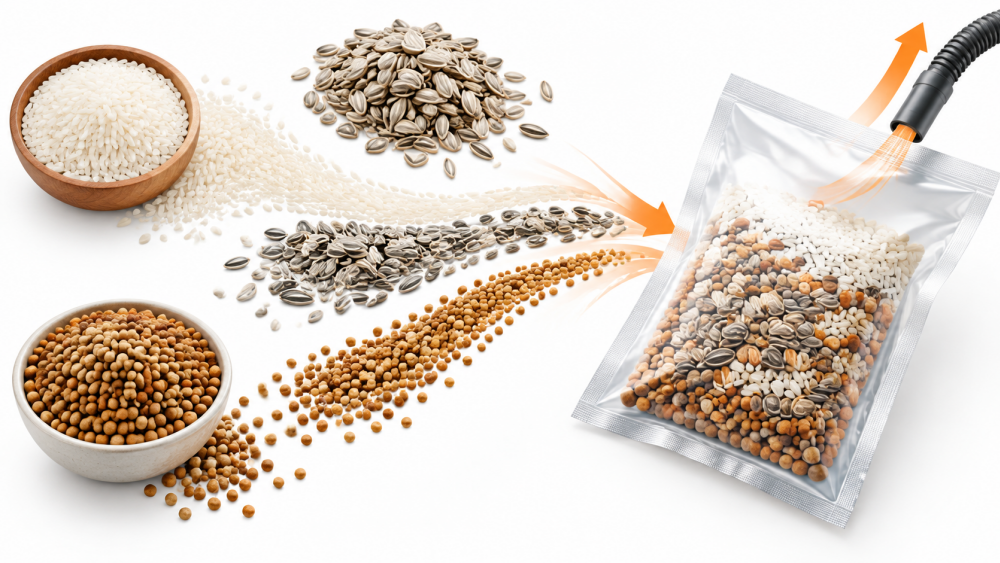
Trapped air between particles: Every gap between grains is a pocket of air that the pump must eventually remove, and granules do not let it go easily. Air paths through a dense grain bed are narrow and tortuous, so evacuation takes longer than bag volume suggests. This is why a rice vacuum packaging machine typically runs longer or staged cycles, and why two products with the same bag size can need different cycle programs. Residual inter-granule air is also why under-evacuated rice bags soften on the shelf weeks later.
Dust at the seal, always at the seal: Milling and handling generate fines, and electrostatic charge walks them to the bag mouth, precisely where jaws close. A particle trapped in the seal creates a channel that leaks slowly and invisibly. Equipment answers exist, cleaning schedules, bag-mouth designs, vacuum-assisted jaw cleaning, but the sealer vacuum packaging machine section deserves disproportionate attention when the product is granular. Sampling finished bags for leak tests belongs in the weekly routine, not just commissioning.
What this means when comparing equipment: Ask each supplier how their machine handles exactly these three points: evacuation profile per product, seal area protection against fines, and demonstrated broken-grain results on a material like yours.
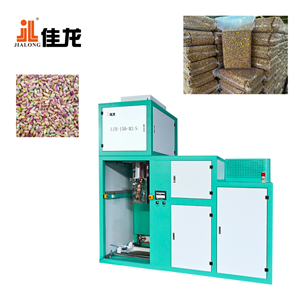
Trials close the gap: Granular behavior resists prediction, so the practical route is a trial with your own product at the builder's facility or a demo machine nearby. Zhangzhou Jialong Technology Co., Ltd. runs product trials for rice, seed and pellet applications and documents configurations at https://jialongpacking.com/ for buyers preparing specifications.
On a granular product line, industrial vacuum packaging settings should be checked against the film and bag weight production will actually use, not a demo substitute.
Accept a rice vacuum packaging machine on corner integrity and residual air, not on cycle time alone. Hold a signed granular product sample brick from the trial and compare new batches against it.
Humid weather changes how a grain vacuum packing machine handles granular product material, since fines cling and hoppers bridge. Keep one summer and one winter recipe rather than forcing a single setting through both.
A grain vacuum packing machine set for wheat will not automatically suit sorghum or paddy, because density changes how much air sits between kernels. Ask the builder to demonstrate at least two granular product grades and record both recipes.
Set a review point for the industrial vacuum packaging section after the first granular product season. Residual oxygen readings, seal hardness and reject counts from that period say more than the original demonstration.
When a granular product bag fails in transit, the fault is usually the seal rather than the pump. Pull three bags from that batch and inspect the sealer vacuum packaging machine jaw face for residue before ordering new film.
During a granular product trial, ask to see the sealer vacuum packaging machine at two production speeds. A seal that holds at slow speed can wrinkle or bridge once the line runs at its normal rate.
A rice vacuum packaging machine handling both 2 kg and 5 kg packs needs stored recipes, because evacuation depth and press time differ with bag volume. Keep both recipes printed beside the granular product station.
On a granular product site, a grain vacuum packing machine earns its keep through repeatable brick hardness rather than peak speed. Press three bricks from every shift and compare them against the acceptance sample.
Industrial vacuum packaging protects granular product quality only when the line around it is steady, so treat feeding, weighing and sealing as one chain. When one stage slows, the vacuum stage inherits the mess as uneven fills and loose seals.
Rice, seeds and pellets share one trait that solids do not: air trapped between particles. That is why industrial vacuum packaging for granular foods lives or dies at three points, trapped air, dust at the seal and grain breakage. Ask your supplier how each is handled on their machine.