Mechanical Analysis of Surface Friction Coefficients and Mono-Material Thermal Sealing
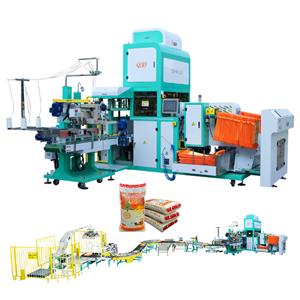
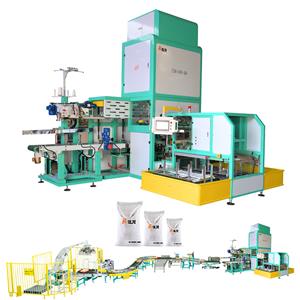
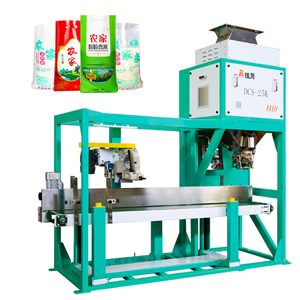
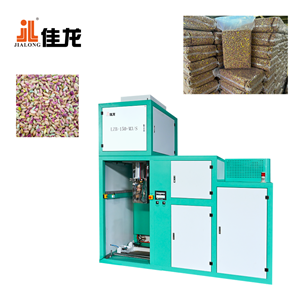
The physical mechanics of high-pressure extraction produce a rigid geometric block enveloped in a highly tensioned polymer film. While this structural state ensures an absolute atmospheric barrier, the resulting smooth surface exhibits a dynamic friction coefficient frequently falling below 0.2. During multi-layer stacking, this lack of friction induces relative sliding between individual units, mathematically guaranteeing structural collapse under transit vibrations. To resolve this logistical constraint, facilities deploy an advanced rice vacuum packing machine. By utilizing precision-machined sealing jaws, engineers integrate localized rough-treatment embossing directly into the composite barrier. Integrating robust automatic palletizing systems manages the load geometry, while a vacuum sealer for packaging ensures strict compliance with mono-material processing standards. A commercial 25 kg rice packing machine executes bulk handling, seamlessly aligning the payload for downstream bag palletizing equipment.
Structural instability generates measurable labor redundancies and mechanical safety hazards when manual restacking is required. The rice vacuum packing machine utilizes specialized forming molds to introduce engineered anti-slip patterns into the primary film web without compromising the tensile strength. This specific geometrical modification allows the substrate to mechanically interlock during the vertical stacking phase. The automatic palletizing systems accurately align the interlocking mechanisms while applying continuous stretch film tension to secure the perimeter. The vacuum sealer for packaging guarantees no oxidative degradation occurs during the texturing process. The 25 kg rice packing machine processes these adapted substrates at scale, while the bag palletizing equipment calculates the exact center of gravity for each cubic layer.
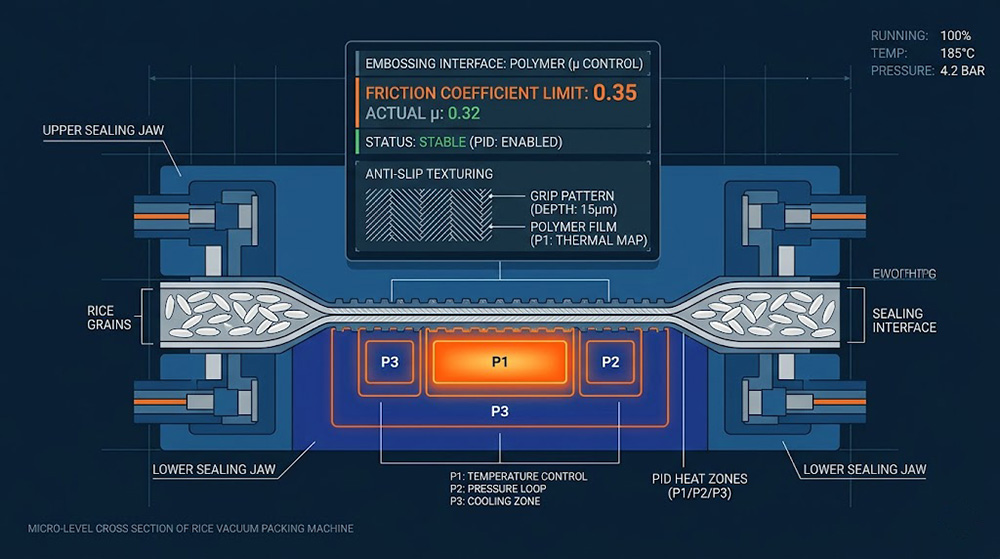
Figure 1: Friction coefficient analysis verifying the interlocking geometry produced by a rice vacuum packing machine.
Mono-Material Processing and Thermal Window Calibration
Beyond physical stacking mechanics, the transition toward sustainable packaging necessitates replacing traditional multi-layer films (e.g., PET/PE) with recyclable mono-materials (e.g., Mono-PE or Mono-PP). However, mono-materials possess an extremely narrow thermal sealing window, making them highly susceptible to melt-through or weak adhesion under standard parameters. A modern vacuum sealer for packaging applies differential PID thermal calibration to prevent structural deformation. The rice vacuum packing machine regulates the exact thermal dwell time required to fuse identical polymer layers. The automatic palletizing systems handle the thermally sensitive packages with precision end-effectors to prevent post-seal stress. The 25 kg rice packing machine maintains continuous indexing speeds despite the narrow thermodynamic limits, ensuring the bag palletizing equipment receives fully cured, structurally sound units.
Objective measurement of standard deviations in seal integrity confirms that thermal control dictates mono-material viability. The vacuum sealer for packaging must maintain precise thermal conductivity, often requiring Teflon-coated jaw upgrades. Operating a rice vacuum packing machine ensures continuous high-speed throughput capabilities despite the added substrate sensitivity. Utilizing automatic palletizing systems natively mitigates the physics of load shifting. Every facility scaling sustainable operations requires a 25 kg rice packing machine to process heavy-duty mono-polymers. Robust bag palletizing equipment remains the core requirement for translating surface friction modifications into stable, global export loads.
| Mechanical Challenge | Hardware Integration |
|---|---|
| Low Friction Sliding | Surface embossing via the rice vacuum packing machine |
| Vertical Load Instability | Geometric interlocking optimized by automatic palletizing systems |
| Narrow Thermal Window | PID loop calibration driven by the vacuum sealer for packaging |
| Heavy-Duty Mono-Material | Tension control secured using the 25 kg rice packing machine |
| Transit Deformation | Center of gravity alignment tracked by bag palletizing equipment |
Contact Engineering for Specifications:
Email: export@jialong.cn
Products: rice vacuum packing machine
Products: automatic palletizing systems
Products: bag palletizing equipment
Products: vacuum sealer for packaging
Products: 25 kg rice packing machine