What Moisture Does to Granular Packaging, and How Lines Fight Back
Moisture ruins granular products quietly: clumped pellets, stale grain, powder that will not flow. Equipment suppliers sell barrier film and deep vacuum as the answer, but water enters through the whole chain, and defending one entrance while ignoring the others wastes money. A line-level view puts each defense where it works.
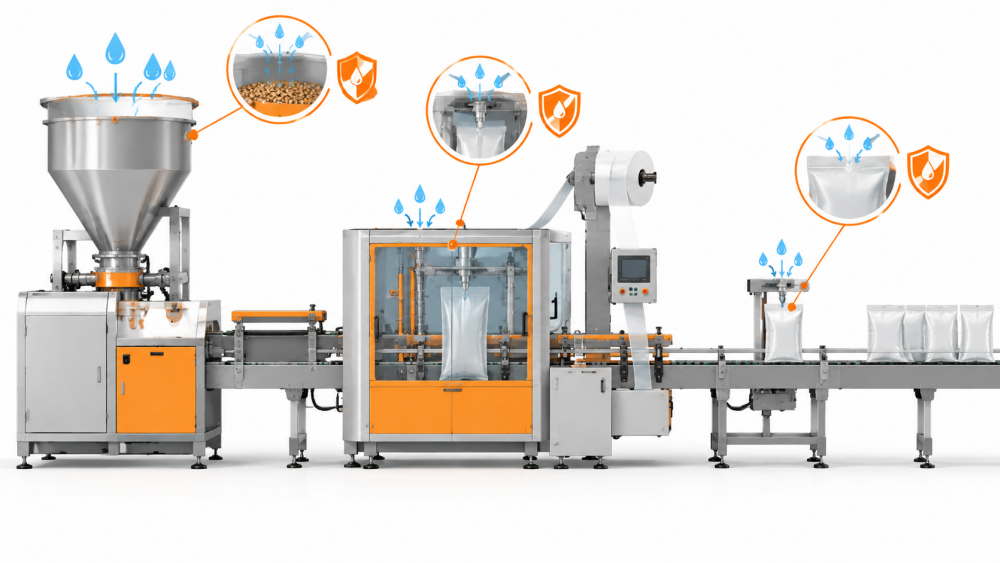
Entrance one: the product arrives wet: No packaging recovers product that enters the line above its moisture specification. Incoming checks, a moisture meter and a reject threshold, defend the whole downstream chain. Storage before packing matters as much as packing itself: open silos in humid weather undo drying work in hours. This is process control, not vacuum packaging machinery, and it is where most moisture complaints actually begin.
Entrance two: the air inside the bag: Atmospheric air carries water, and whatever air remains in the package after evacuation carries it too. Deep, repeatable evacuation reduces that reservoir; a grain vacuum packing machine with staged cycles handles fluffy products that trap humid air between particles. For high-value hygroscopic goods, a nitrogen purge displaces humid air entirely, which is why the option exists on serious machines.
Entrance four: the seal, always the seal: A perfect barrier bag with a poor seal is a broken bag with extra steps. Humid plant air condenses on cool jaw surfaces; product fines absorb moisture and pack into the seal zone. Industrial vacuum packaging lines in humid climates need jaw cleaning routines and, ideally, conditioned air around the sealing station. The sealer vacuum packaging machine section deserves the moisture plan's closest attention.
Defend in order of cost: Incoming control costs least and helps most; evacuation settings are a specification choice; film is a running cost; seal discipline is a habit. Zhangzhou Jialong Technology Co., Ltd. documents moisture-management configurations for granule lines at https://jialongpacking.com/, including purge options and film guidance, for teams assembling a full defense.
Ask how vacuum packaging machinery spare parts are packed and labelled; that detail predicts how quickly a repair can start.
Moisture enters an industrial vacuum packaging line at four points: incoming product, plant air, film surface and the seal. A grain vacuum packing machine can only manage what it controls. A sealer vacuum packaging machine with a dry, clean seal area helps, and an automatic vacuum packer with good diagnostics shows where the moisture is coming from before it becomes a claim.
Moisture control starts before the automatic vacuum packer: dry incoming product, dry plant air and dry film. The machine manages the seal environment, and a record of vacuum depth and seal temperature shows where the water entered before it becomes a claim.
Moisture control on vacuum packaging machinery starts upstream: dry product, dry air and dry film. An automatic vacuum packer manages the seal environment, and industrial vacuum packaging holds the barrier once the bag is closed. Fix the source before adjusting the machine.