The Growing Trend of Vacuum-Packed Nuts: Health, Shelf Life, and Better Distribution
Why vacuum-packed nuts keep selling
Published on: July 22, 2026
I'll tell you what I keep hearing from the buyers who actually run vacuum-packed nut lines, which is that the format wins on the warehouse floor before it wins in the marketing deck, and the reason has almost nothing to do with packaging as a concept and everything to do with what a kernel inside a sealed bag does six weeks after it leaves the line. The bag, plain and simple, holds the crunch where the kernel itself cannot, and a kernel that still snaps when a customer opens the bag is the kind of thing that gets reordered, which sounds obvious when you write it down but is genuinely hard to defend without a decent pack behind it.
Oxygen is the enemy here, and most processors already know it, so I won't spend a lot of time on the chemistry — what I'll say is that the oxidation curve on shelled nuts is not the slow drift people assume it is in the lab, it's the kind of curve that flattens for the first three weeks and then tips over the line somewhere around week four, which is roughly when the customer in another country is opening the bag they ordered through a distributor, and that is the moment the format either earned its keep or didn't. You can keep a vacuum on a bag in storage and you can keep dust out and you can keep pests out, and all three of those are problems that bite you faster than you'd think once a pallet sits in a humid warehouse for ten days.
On the premium end this matters more, not less, because buyers there are judging the kernel partly by what's in front of it, and a 250g mixed pack that comes through with a scuffed window or a seal that takes two thumbs to break is on its way to a buyer's complaint folder the day it lands. I've watched retailers price competing products and the cheaper pack almost always loses on second order, because the first order was the photo, the second order is what the customer remembers eating.
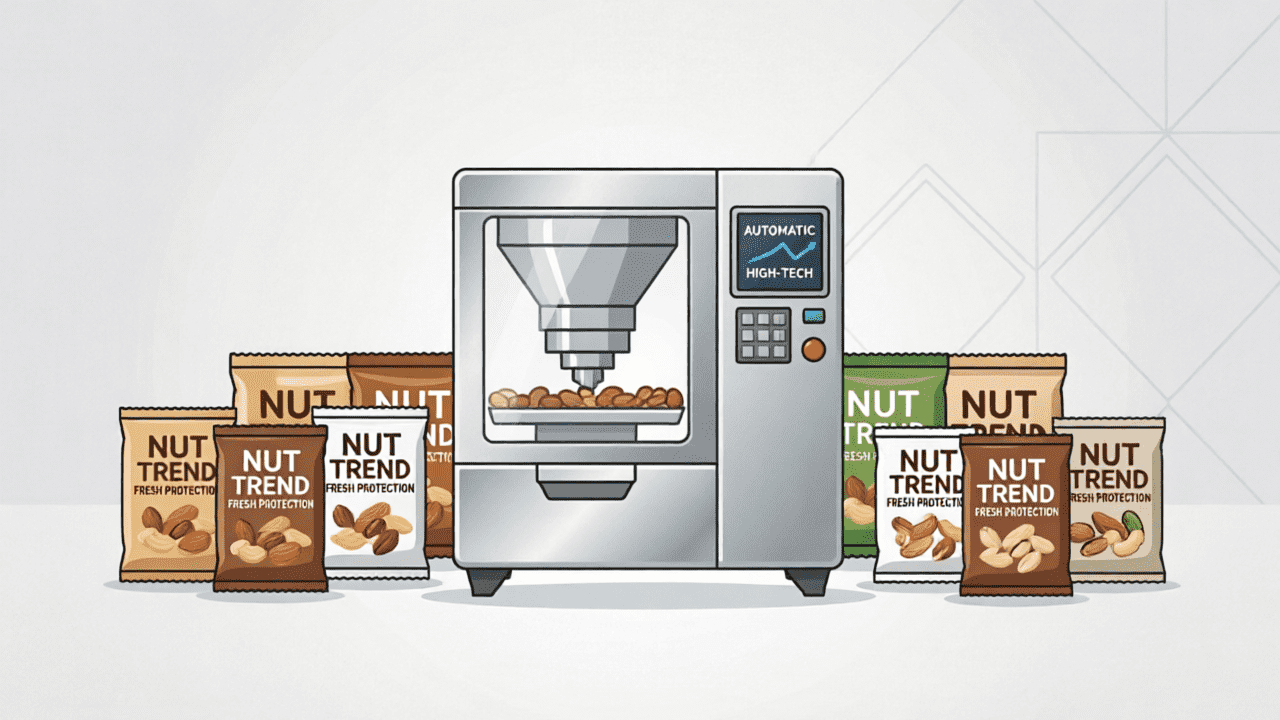
What I think trips lines up is the assumption that vacuum is doing the work by itself. The vacuum pulls air out, sure, but what it doesn't do is keep a kernel intact during a parcel sortation system, which is where most online orders end up, and it doesn't help the bag look any good on a shelf where the customer picks it up and puts it down a couple of times before deciding. A pack that holds flavor in a warehouse can still leak in a courier's chute, and that distinction is the one that separates a clean trial from a returns complaint six weeks later.
There's a version of this where the film scuffs on the shelf or the kernels shatter during filling, and either of those quietly kills the premium feel that justified the price tag in the first place. Honestly, those are the calls I'm taking most often right now: the line ran clean for a month, then second-shift starts and the seals start looking tired, and the order book shows what that costs within two months.
For nuts sold as much on appearance as on crunch, the package carries more of the brand than most processor-packagers give it credit for, and you can see it in the segments that earn the higher margin — a mixed pack at a farm-shop price behaves completely differently from a 1kg export bag because the customer assumes different things about each, and the bag either meets that assumption or breaks it before the kernel has a say.
Before anyone commits to a format on a quote, the cheapest test is to ask for four pieces of data: barrier level, breakage rate after a real fill, seal face after a 24-hour hold, and how the bag looks once it's been dropped from a meter onto a hard floor twice. Those four numbers usually settle it; the rest is presentation.
And the reason the growth story holds is honestly a boring one, which is that the math works in a way that novelty formats don't — every percentage point of breakage you cut from a 1kg bag is a number you can defend at the quarterly review, and a pack that holds crunch for four weeks in a sea-freight container is something customers reorder without checking, which is the sort of reorder habit that outlasts packaging trends by a decade.
Open a finished pack the way a retail customer would. Smell it before you bite, then bite, then look at the broken pieces at the bottom of the bag, then look at how the seal ran along the heat mark. If the bag smells nutty and snaps but the seal pulls apart in your hand, the line still has work. The two things, freshness and how it presents itself on the shelf, ought to travel together — and if they don't, one of them is lying.
Reach the Jialong export desk:
Email: export@jialong.cn
WhatsApp: +86-136-2579-4992
Products: nut packaging machine