Thermodynamics of Barometric Expansion and Granular Densification
Technical Analysis of Granular Densification and Altitude Pressure Differentials
Published on: May 19, 2026 | By Jialong Mechatronics Desk
The physical mechanics of removing atmospheric gas from a dense granular mass inherently alter the interstitial spacing between individual grains. Under continuous negative pressure, the crystalline starch structure compacts, significantly increasing the overall bulk density of the package. When consumers utilize traditional volumetric measuring tools, this artificial densification leads to inaccurate water-to-grain ratios, fundamentally altering the optimal gelatinization process during cooking. To resolve this functional discrepancy, packaging facilities rely on a specialized rice vacuum packaging machine equipped with inline printing capabilities. Operating a modern automatic vacuum sealing machine allows production lines to print dynamic QR codes directly onto the film, linking consumers to adjusted hydration parameters based on the exact compression metrics generated by the hardware.
Addressing structural densification requires precise control over the extraction curve. A standard pneumatic system lacks the algorithmic buffering necessary to prevent over-compression. Integrating a PLC-controlled double chamber vacuum packing machine enables operators to establish exact negative pressure limits (e.g., stopping extraction at 0.08 MPa). Furthermore, utilizing a nitrogen vacuum packaging machine allows the introduction of a calculated volume of inert gas prior to the final seal. This positive pressure buffers the granular load, maintaining a more natural volumetric state. An elite industrial food vacuum packaging machine ensures absolute parameter consistency across continuous production cycles, directly stabilizing the end-user's culinary experience.
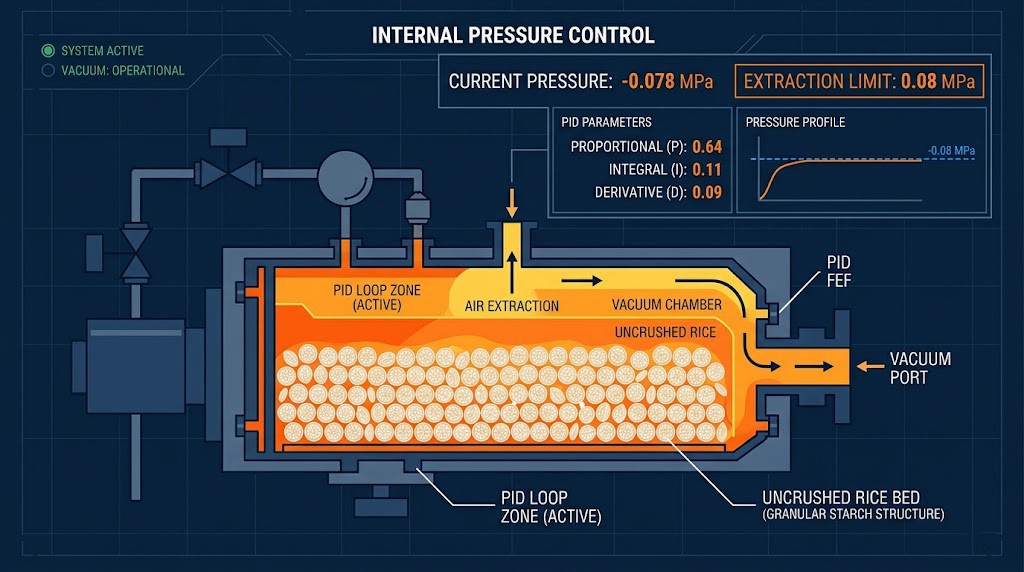
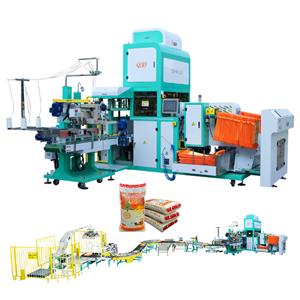
Figure 1: PID control interface of a rice vacuum packaging machine managing exact extraction thresholds to prevent extreme densification.
Atmospheric Physics and Altitude Stability
Beyond consumer measurement deviations, geographical elevation presents a critical structural challenge. According to the barometric formula, atmospheric pressure decreases exponentially with altitude. When standard rigid packages are transported to elevated regions, the trapped internal gases expand as external pressure drops, exerting severe mechanical stress on the composite seams. This physical expansion frequently results in material bursts. To neutralize this logistical variable, the automatic vacuum sealing machine integrates specialized applicator modules that fuse micro-porous pressure valves into the secondary film layer. These valves automatically equalize the internal and external differentials without compromising the oxygen barrier.
Alternatively, manufacturers utilizing regional production strategies adjust their preservation methods entirely based on the destination. A high-torque double chamber vacuum packing machine guarantees that the thermal dwell time penetrates the dense, multi-layer barrier required for valve integration. For extreme altitude routes, deploying a nitrogen vacuum packaging machine replaces the absolute vacuum strategy with a balanced positive-pressure flush. This actively prevents the physical contraction and subsequent expansion cycle altogether. An industrial food vacuum packaging machine calculates these thermodynamic shifts systematically. Mastering these integration points ensures that the rice vacuum packaging machine operates efficiently regardless of the final supply chain topography.
| Mechanical Challenge | Hardware Integration |
|---|---|
| Cooking Parameter Deviation | Inline QR printing via the automatic vacuum sealing machine |
| Micro-Valve Sealing | Thermal mapping optimized by the double chamber vacuum packing machine |
| Altitude Burst Prevention | Positive flushing driven by the nitrogen vacuum packaging machine |
| Volumetric Consistency | Extraction limits secured using the industrial food vacuum packaging machine |
Objective measurement of standard deviations in film tension confirms that mechanical stability dictates supply chain survival. The automatic vacuum sealing machine must maintain precise thermal conductivity to prevent degrading the micro-valves during the indexing phase. Operating a double chamber vacuum packing machine ensures continuous throughput capabilities. Utilizing a nitrogen vacuum packaging machine natively mitigates the physics of barometric expansion. Every facility scaling operations requires an industrial food vacuum packaging machine to adapt to these variables. The rice vacuum packaging machine remains the core requirement for structural integrity.
Contact Engineering for Specifications:
Email: export@jialong.cn
Products: rice vacuum packaging machine
Products: automatic vacuum sealing machine
Products: double chamber vacuum packing machine
Products: nitrogen vacuum packaging machine
Products: industrial food vacuum packaging machine