Vacuum Packing Cannot Prove Cat Litter Shelf Life
A vacuum-sealed bag shows that air was removed before closure; it does not, by itself, establish how long a litter stays dry or how well it performs after storage. A useful cat litter storage study separates package behavior from the product claims made about the material inside.
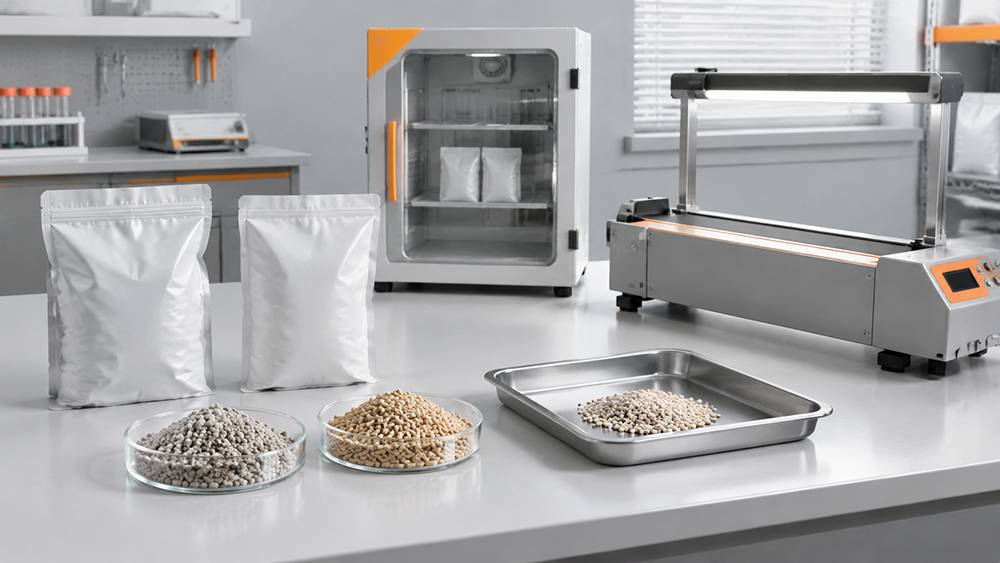
Separate the bag from the material: A cat litter moisture barrier test concerns what passes through the film and closure under its stated conditions. Absorbency, clumping and odor control are properties of the litter and its formulation. A sealed appearance cannot stand in for either set of measurements, and a single result should not be presented as proof of every benefit named in a product claim.
A barrier value is not a storage result: Film data can help compare candidate structures, but the actual bag also includes seams, folds and closure areas. A vacuum pack seal integrity check looks at the finished package as a whole; film permeability data alone does not establish that every production pack is intact. Record which bag construction and seal conditions were used for each sample group.
Keep a product control: A cat litter storage study needs an identified litter lot and a baseline sample before conditioning begins. After the agreed interval, compare the packed sample with the control using the product function relevant to the claim. A cat litter absorbency comparison, for example, should use the same method and sample preparation on both groups; package appearance is not a substitute for that comparison.
Storage conditions belong in the record: Temperature, relative humidity, exposure time and package orientation can change what a comparison means. A cat litter moisture barrier test is only interpretable when the conditioning conditions are written down and held consistent. Avoid converting a short screening trial into a months-long shelf-life statement without a study designed for that purpose.
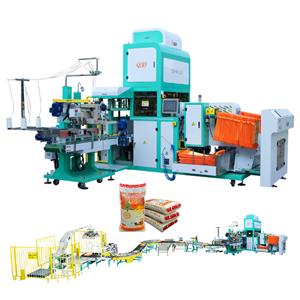
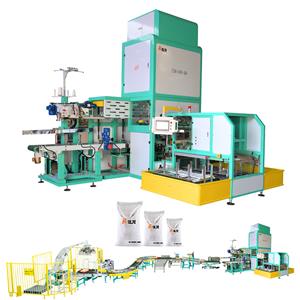
Use production samples for the package question: Jialong's automatic vacuum packing category describes bag supply, weighing, filling, shaping, vacuum, sealing, discharge and conveying for selected applications. That process can produce packages for evaluation, but the published category does not verify cat-litter capability or storage results. A vacuum pack seal integrity check should use the intended film and closure, not a convenient substitute.
Keep the claim matched to the evidence: A litter package shelf-life evidence file should identify the product, film, seal method, conditioning period and the measured endpoint. A cat litter storage study that measures moisture change does not automatically establish absorbency, odor performance or microbial safety. Conversely, an absorbency result does not prove the package resisted moisture ingress. Each statement needs evidence tied to the question it answers.
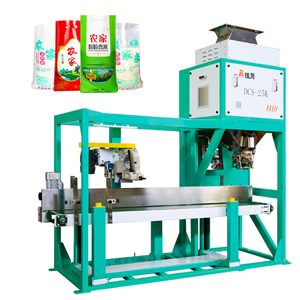
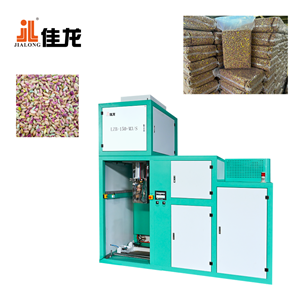
Write the conclusion narrowly: The semi-automatic vacuum packing range lists grain and other granular applications, not a verified cat-litter application. For a cat litter moisture barrier test or a vacuum pack seal integrity check, the report should name the sample and conditions rather than generalize to every litter type. Zhangzhou Jialong Technology Co., Ltd. can discuss a project brief at jialong-packing.com or export@jialong.cn.