Weighing Accuracy: The Quiet Foundation of Every Packing Line
Discussions of packing lines circle vacuum depth and seal quality, while the least visible parameter quietly sets the economics: how accurately each dose is weighed. Every gram of systematic overfill is donated forever; every underweight bag is a claim waiting to happen. Accuracy deserves the same engineering attention as any vacuum parameter.
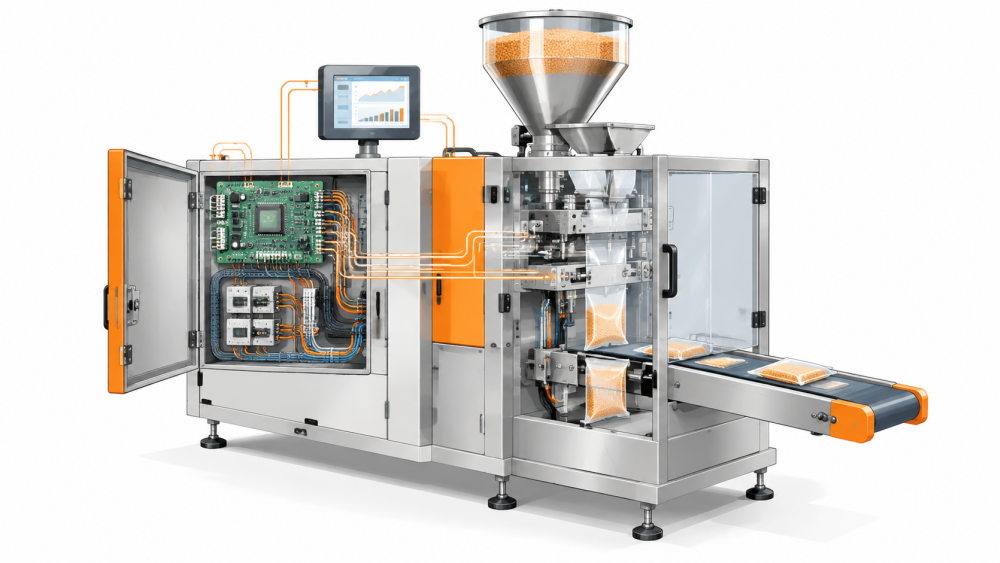
How a quantitative packing machine builds accuracy: Modern dosing combines coarse and fine fill: most of the weight arrives fast, and a final trickle tops up precisely. The controller cuts the flow based on the last few cycles, compensating for material density changes. That closed-loop correction is the core of electronic weighing on a particle vacuum packaging machine, and its quality, sensor resolution, filter design, cut timing, separates accurate dosing from nominally accurate dosing.
Where accuracy leaks away: Product build-up on the weigh hopper shifts the zero point; vibration from nearby conveyors disturbs the reading; air currents from open doors bias light materials. Each leak is small, and together they push the distribution until operators respond by widening the safety margin, which is donation by another name. A packing scale needs a stable zero, vibration isolation and clean sensing surfaces to hold its rated accuracy. Two weeks with your own material answers most doubts about whether the proposed line suits the product.
Trade laws set the floor: Most markets regulate declared weight on consumer packages, with permitted negative errors. Exporters face multiple regimes. The practical response is designing to be comfortably inside the strictest regime you sell into, verified by records, because a weights-and-measures finding disrupts retail relationships far beyond the fine. Once a full season of production has run, the questions buyers ask about a packing line start to change.
Specifying accuracy honestly: State target weight, tolerance and the verification method in the equipment specification, not just "high accuracy." A granule packing machine quotation that answers with a concrete standard deviation at your target weight is measurable; one that answers with adjectives is not. Zhangzhou Jialong Technology Co., Ltd. specifies weighing performance and verification practice at https://jialongpacking.com/ for project buyers.
Keep the quantitative packing machine log next to the scale and write the ambient humidity beside each calibration. On granular product runs, moisture changes flow behavior faster than most operators expect.
A recipe tuned for free-flowing material will overshoot when fines or humidity slow the flow.
An automatic weighing and bagging machine should be checked after any frame repair, not only at calibration time. On a granular product line, a shifted sensor bracket shows up first as scatter, then as rejected bags.
An automatic weighing and bagging machine couples two failure modes: wrong weight and bad transfer into the bag. Record both metrics per shift on the granular product line, because fixing one while ignoring the other wastes the audit.
A quantitative packing machine should be audited with ten consecutive bags at three different target weights, not just the one you usually ship. On a granular product line, this exposes drift that a single-point check misses.
During acceptance, run the automatic weighing and bagging machine through at least one granular product grade change and log how many bags it takes to return to target. That number belongs in the contract appendix.
An automatic weighing packing machine quietly sets the limits of a packing line: giveaway, rejects and customer trust are decided before the sealer stage. In a connected packing line, weight data becomes the reference for the rest of the process. When the scale is accurate, the particle vacuum packaging machine inherits fewer complaints and less rework.
An automatic weighing packing machine protects the margin before any sealing work begins. On an integrated packaging line, downstream decisions use the weight record, and the particle vacuum packaging machine is the point where that record becomes a sealed pack. Accuracy upstream is cheaper than rejection downstream.
A quantitative packing machine sets the target, an automatic weighing packing machine holds it, and the integrated packaging line carries both into the batch record.
An integrated packaging line carries those weight records into the batch history, so accuracy becomes a process rather than a one-time calibration.
An integrated packaging line also turns those records into a trend. When an integrated packaging line shows weight drift across two shifts, maintenance can be scheduled before customer complaints start, which is usually far cheaper than a full recalibration after a rejected batch.