What Is a Vacuum Forming Packaging Machine? Process Logic and Practical Uses
What a vacuum forming packaging machine actually does
Published on: July 24, 2026
A vacuum forming machine takes a flat plastic sheet, softens it with heat until it sags, drapes it over a mold that decides the shape, and seals a lidding film on top once the cavity's drawn — that four-step loop is the same whether you're packing screws or sliced ham, which is why the format ends up in so many categories that have nothing to do with each other on paper. The shoppers who go for it usually have a pack that needs to hold its shape on a shelf and survive the trip there, which sounds modest until you watch a flat pouch collapse and a formed tray hold up under the same stack of boxes.
The part most first-time buyers underweight is the heater balance, which is the kind of thing the brochure never describes well because the heater is just a panel of cal rods to most engineers until you run the line on a 0.4mm APET and find out that the corners of a 220mm wide sheet are a full six degrees cooler than the middle, and that's the reason trays come out thin in the corners, which is the exact complaint nine out of ten first-time buyers send in. It's a slow lesson to learn.
The same machine can run APET and PET for clear retail trays, PP for microwaveable packs where the pack has to survive the reheat, and PS for cheap blister-style applications where the appearance doesn't really matter to anyone — so the "vacuum forming packaging machine" tag covers a wider material range than the buyers typically assume, and the line you price for PET is not necessarily the line that runs PS to the cycle time the seller quoted.
In food, you'll see this format on meat trays, cheese wedges, ready meals, the occasional bakery punnet — anywhere a frozen or chilled product needs to be held in a specific shape and shown through the film. Outside food, the same line shows up on electronics where the part absolutely cannot rattle in transit (an HDMI cable in a formed cavity is a different product from an HDMI cable in a poly bag, once the courier gets hold of it) and on hardware kits where every screw wants its own pocket so the buyer at home doesn't have a bag of mixed fasteners to sort through at midnight.
My honest two cents on buying one is to forget cycle time for a week and go look at forming depth instead, because a machine that forms 4mm deep is not the same machine as one that forms 35mm, even if the brochure says otherwise — and the mold change time on a 35mm tool on a light frame is going to eat a chunk of your operating day in a way the quotation did not warn you about, while the seal strength on a deep cavity is yet another variable that doesn't show up until you're already past the deposit.
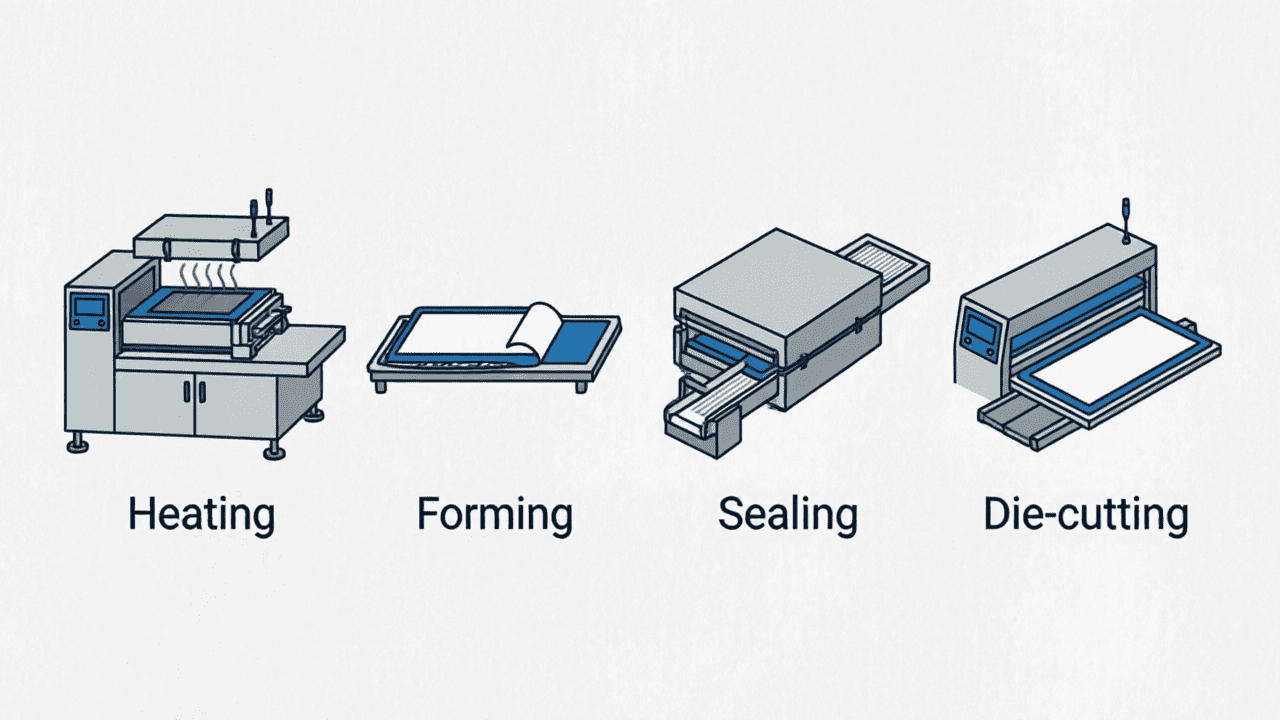
Material choice is where the spec sheet starts to actually earn its keep — APET and PET are clear and stiff enough to show the product, which is why most retail packs lean on them, PP is what you go to if the customer is going to reheat the pack in a microwave once they get home, and PS has its place for blister-back applications where the tray is a backing card more than a container. The thickness on the roll drives both the look and what the pack costs you per tray, mind you, and a film that's undersized for the depth will show whitening marks at the corner the instant a packed tray sits under a heavier tray for an afternoon, which is when first-time buyers usually call us.
Mold cost is the line item that gets dropped during the first round of negotiations because nobody wants to talk about it, but it's there, and the aluminum machined tools hold their dimension longer than the 3D-printed ones, while the printed ones are how you get to market in four weeks instead of ten. For a 2000-pack market test the printed mold is the right answer; for a year of production the aluminum pays for itself, and the trap is thinking the two are interchangeable just because the cavity looks the same on a sample card.
What the spec sheet doesn't say is that the seal is doing different work than most buyers assume, because on a formed pack the seal isn't just joining two pieces of film, it's also the part of the pack that's expected to hold up after the tray's been through a chiller and a pallet and a trip across a city and the inside of someone's fridge for a week — and the seal pressure on a deep cavity is yet another setting that drifts on you after a few thousand cycles, which is one reason some lines run a morning sample and an afternoon sample before they trust the day.
Try to look at repeatable forming quality before you look at cycle speed, because what tends to happen on a heated sheet is that the cavity depth will drift by half a millimetre on the second shift if the heater's been running all day, and that's enough to leave a lid loose on a tray that looked fine at 9am — and we have watched lines lose an entire afternoon to a heater that drifted for two reasons nobody was watching, the ambient humidity in the room having gone up, and the chiller on the mold having iced over just enough to slow the draw.
Once a tray leaves the line, by the way, the test that actually tells you anything is to leave a sample under a 1kg weight on a countertop overnight and see if the seal still holds and the corner hasn't crept open, because retail is much harder than the demo room — pallets get dropped, shelves get squeezed, packs get pulled out by the corner and not by the front, and a tray that looked rigid on the bench will eventually crack along a thin wall if the wall is, say, 0.6mm in a 60mm-deep cavity, which is the kind of detail you only find out about after you've shipped 200 packs.
Some teams keep a one-line note when a sample works, which is fine, though what's worth recording isn't really a list, it's more like — did the seal survive the 24-hour chill, did the corner hold the drop, what's the cycle rate on a Wednesday afternoon after the morning's run, all of which is less memorable than it sounds until the same product comes back six months later and you're trying to remember why you picked that tool.
If you have a line you can actually change a mold on in under an hour, the format's usually worth the trouble, because changeover is where most of the surprise cost hides on a vacuum forming line, and a slow changeover will quietly cancel out whatever cycle speed the brochure promised — operators who are still tweaking at minute 45 of a 30-minute changeover are not running the line the brochure was sold against, even if every other metric is right on the page.
For me the practical move has always been to run a half-day on the line with the actual product and the actual roll of film before anything is paid in full, because the gap between the brochure's cycle time and what your film and your operator and your room temperature will give you is one of those gaps that always shows up in the second shift and almost never shows up at 10am on a Tuesday when the seller's engineer is still standing next to you, and the buyers who walk into volume with that gap already measured are the ones who don't end up with a pack format they can't repeat.
Reach the Jialong vacuum forming desk:
Email: export@jialong.cn
WhatsApp: +86-136-2579-4992
Products: thermoforming vacuum packaging machine